"In disputes upon moral or scientific points, let your aim be to come at truth, not to conquer your opponent. So you never shall be at a loss in losing the argument, and gaining a new discovery.” - Arthur Martine
What does it mean to critically engage with Planet Of The Humans, through the lens of media literacy?
To me, that means examining and acknowledging the film's merits as well as its flaws.
It's not obvious which parts of the film are misleading simply from watching it. Reading reviews and critiques of the film is pretty much required to understand the complexities of the issues brought up.
But the film isn't entirely bad, and critics of the film would be wise to acknowledge the film's good points, as the best critics do.
I've done my best to model the sort of nuanced, critical, and charitable mindset that I hope to see in wider discussions around the film.
See what you think.
1. We still need to transition to 100% renewable energy. There is no other option. But the delusion that we need to dispel (which the film gets right) is the idea that renewables can power our industrial civilization as is, and that these technologies are entirely 'green' when they are themselves still harmful.
They are far less harmful and more sustainable than fossil fuels, and therefore we need to get to 100% renewables as fast as possible, but scaling up these energy sources to meet the energy demands of our current civilization will be impossible and highly damaging to the planet if we go on thinking the raw materials for these things are infinite.
We need to power-down our civilization. Renewables + dramatically reduced consumption of energy and resources is the solution - not simply renewables alone, and our capitalist/consumer society has not grasped that reality.
We believe that is the most important takeaway from the film - but it's pretty unfortunate that the film makes some pretty erroneous claims along the way (like when Ozzie Zehner says, "You would have been better off just burning fossil fuels in the first place, instead of playing pretend.”).
Read a few reviews at the bottom for more on that. I avoided repeating points from those reviews for brevity.
2. Green capitalist co-opting of environmental groups is a serious problem. This has been a critique within the environmental movement for a long time, hence the ever-lasting tension between mainstream groups and the groups that always seem to get far less attention, including in this film.
3. Despite the many flaws in its details, the film is asking us to come to terms with some difficult realities which we have yet to face: namely, that sustaining our infinite growth, industrial civilization on renewables is neither desirable nor possible, yet that is exactly what green capitalists are intent on pursuing.
We need to Power Down. We need Economic Degrowth. (Click the links!)
Instead of 'growing the economy' forever - which amounts to ecological devastation of the planet year after year for the sake of 'profit' - we should focus on growing everything that actually matters in reality: biodiversity, wilderness restoration, healthy soils, air and water, human happiness and wellbeing, social trust, meaning in our lives, etc.
4. At what point are we going to decide, politically, that we ought to share the last remaining bits of wilderness on Earth with the rest of the community of life? At what point are we going to stop bulldozing the wilderness at the edges of every city and say enough is enough? For this reason, we think small-scale, decentralized solar & wind energy should be pursued over large-scale, centralized projects. This means we'd be putting solar and wind on rooftops in the cities and already "developed" land, allowing us to leave more land untouched.
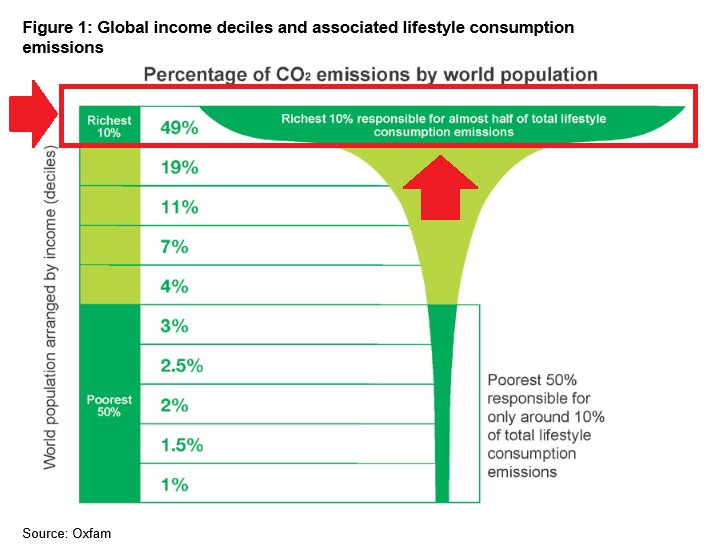
5. Overpopulation is a red-herring. It's true we can't keep growing forever, in the same way we can't keep consuming the Earth forever, but in high-consumption countries, populations are already declining, and in areas where populations are still growing, the "impact on Earth" is still low compared to the impact of "rich" nations. The truth is, pinning our problems on population lets industrial capitalism off the hook - what Daniel Quinn called the culture of maximum harm.
*
6. The film never once mentions permaculture? As the editor of this site, I'm aware of hundreds of positive ideas, solutions and experiments in new ways of living all around the world, which are essentially answers to the filmmakers' despairing question, "where do we go from here?" It's painful to think about how all this positive knowledge is still not getting the attention it deserves while this FUD (Fear, Uncertainty & Doubt) is getting the global spotlight.
7. The film has created a heightened awareness of our energy and consumption problems. This is an opportunity for us to point people towards the best solutions, knowledge and resources that can guide us in the right direction. A few sites that come to mind: Energy Reality. The Post Growth Encyclopedia. Transition Network. Resilience. This library. What else?
8. It's true, we'll never have ecological sustainability without limits to growth.
9. Despite the film's scathing critique of mainstream environmental groups, the filmmakers have been surprisingly conciliatory in their post-release discussion. As Michael Moore said in a podcast, "We're not coming after you, we need you." And as Jeff Gibbs echoed in an interview with Rising: "We don't attack any environmental leaders. We need our environmental leaders. We're just in the wrong story." It's a bit sad though that tons of people watching the film are not taking the same, compassionate stance.
10. When I listen to the filmmakers speak about what they hope people will get from the film, I agree with their meta-level conclusions (that we need to question our economic addiction to growth, to reduce our consumption, to challenge capitalist greenwashing, and to realize renewables aren't going to save us, at least without making some other major changes). When Gibbs talks about us being in "the wrong story," I couldn't agree more.
11. Jeff Gibbs said in the interview with Rising that he doesn't believe in or argue for "population control" of any kind. He also repeated this in his FAQ. Since I agree with Bill McKibben that we should avoid "bad faith" assumptions and arguments, I'd say that charges of the film promoting "ecofascism" fall into this category.
12. As Cornell West has said, I don't believe in canceling anybody. I believe we're all brothers and sisters. This includes Bill McKibben, Michael Moore, and Jeff Gibbs. I wrote a guide to compassionate activism because I don't believe love and compassion are luxuries. They are essential to human survival. While we may find ourselves in disagreement, it's important to recognize that we're all on the same team - yes, even the people who oppose us - they're just parts of our family who are tragically bound up "in the wrong story" - the story that sees us as separate from nature and each other.
13. The great tragedy of this film is that it perpetuates one of the central myths of our culture: the myth that WE are humanity. That the problem is "us" when we are just one culture among thousands that have lived on this earth. Indigenous cultures aren't colonizing and destroying the world.
Like most stories "about ourselves and the world" today, the film perpetuates what Daniel Quinn called 'the great forgetting' - a historical amnesia that most people in our culture still suffer from. But if this culture is going to change, it needs to understand that it is not humanity.
This means we need to understand that "humans" are not a virus or a cancer on the Earth. It is one totalizing, homogenizing, globalizing, colonizing culture based on domination, capitalism and separation from nature that is destroying the world.
The fact that this culture has colonized the minds of 95% of humanity still does not mean "we" are humanity. We are still one culture - NOT humanity itself.
Indigenous cultures have been resisting this colonizing, globalizing culture every step of the way, and their resilience and survival in the face of such a force should give us profound hope for the future.
A primary reason indigenous cultures are so consistently erased from our collective awareness is because they are living proof that we are not humanity; that we are still just one particularly destructive monoculture.
As Daniel Quinn taught me, this is profoundly good news. If "we" were truly humanity, then it's true, we might be doomed. But since we're not, there is hope.
The only thing that gives our culture its power is the unexamined ideas and beliefs in our own heads.
Change that, you change everything.

Reviews
(Media Literacy Note: We should apply our critical thinking skills to these reviews as much as the film. To me, this means giving credit to an author's good points while taking stock of any weak points, but not allowing the weak points to discredit the good points, or allow the good points to let us mentally gloss over or excuse the weak points. We should evaluate each argument on its own merits.
We should also be wary of motivated reasoning and confirmation bias. If we liked the film, we may scan reviews for objections but quickly find reasons to dismiss fair arguments while focusing on the weakest arguments, giving us a reason to dismiss the review entirely. Likewise, if we find ourselves critical of the film, we may gloss over or accept weak arguments uncritically while failing to acknowledge the film's merits.
Ultimately, I don't see reviews as a means to prove or disprove whether the film is good or bad. I see them as a media literacy exercise through which I can learn more about all the issues the film brings up. I've learned a ton from reading the reviews below. Clicking on many of the links in the reviews (including many of the links I've sourced above) have sent me on all sorts of rabbit-hole journeys of knowledge discovery. If we all embrace this spirit of curiosity, the journey is sure to be time well spent.)
My Favorites:
Planet of the Humans: What They Get Right and the Environmentalists Get Wrong - Paul Fenn
Triggered: “Planet of the Humans” & A Call for Emotional Intelligence - the Good Grief Network
‘A Bomb in the Center of the Climate Movement’: Michael Moore Damages Our Most Important Goal - Bill McKibben
Rebel Bass Planet of The Humans Review: A Missed Opportunity - Rebel Bass
Bill Mckibben and a Call to Hold People in Their Fullness - Tim Hjersted
Richard Heinberg's Review (Richard is one of the "good guys" featured in the film. I've long held a lot of respect for him. If you value a diversity of perspectives in your media diet, his voice is an important one)
Let's Just Have a Think... a 30-minute video review by Just Have a Think.
Connect the dots - Why we still need the green new deal plan for 100% clean energy (podcast)
The Bizarre Blindspot in 'Planet of the Humans' - Craig Collins
Skepticism Is Healthy, but POTH is Toxic - Vote to Survive
Michael Moore’s environment film a slap in the face on Earth Day - Cathy Cowan Becker
"Damn Dirty Humans!": 'Planet Of The Humans' And Progressive Denial - John Halstead
The Great Giving Up (and The Film that Made It Worse) - Ketan Joshi
Even More Reviews
The Important Debate Planet of the Humans Misses - Kate Aronoff
Planet of the Humans backlash - Yves Engler
6 Reasons Why “Planet of the Humans” is a Disaster of Misinformation - Ben Wehrman
POTH, a weak documentary on sustainable energy - Thijs Ten Brinck
EcoEquity's Review (on why the bad stuff ruins the film as a whole, despite its good points)
This review of Biomass (it is indeed awful)
Michael Moore's 'Planet of the Humans' documentary peddles dangerous climate denial - Dana Nuccitelli
A ReHeated Mess of Lazy, Old Myths - Ketan Joshi
Moore’s Boorish Planet of The Humans: An Annotated Collection - A Siegel
The Solar Nerd's Review
Bill McKibben's first response.
Director Jeff Gibbs' response to Bill McKibben (published April 30th)
Setting the Record Straight About Renewable Energy - World Resources Institute
5/12 Michael Moore's old fact-checker has responded to the film:
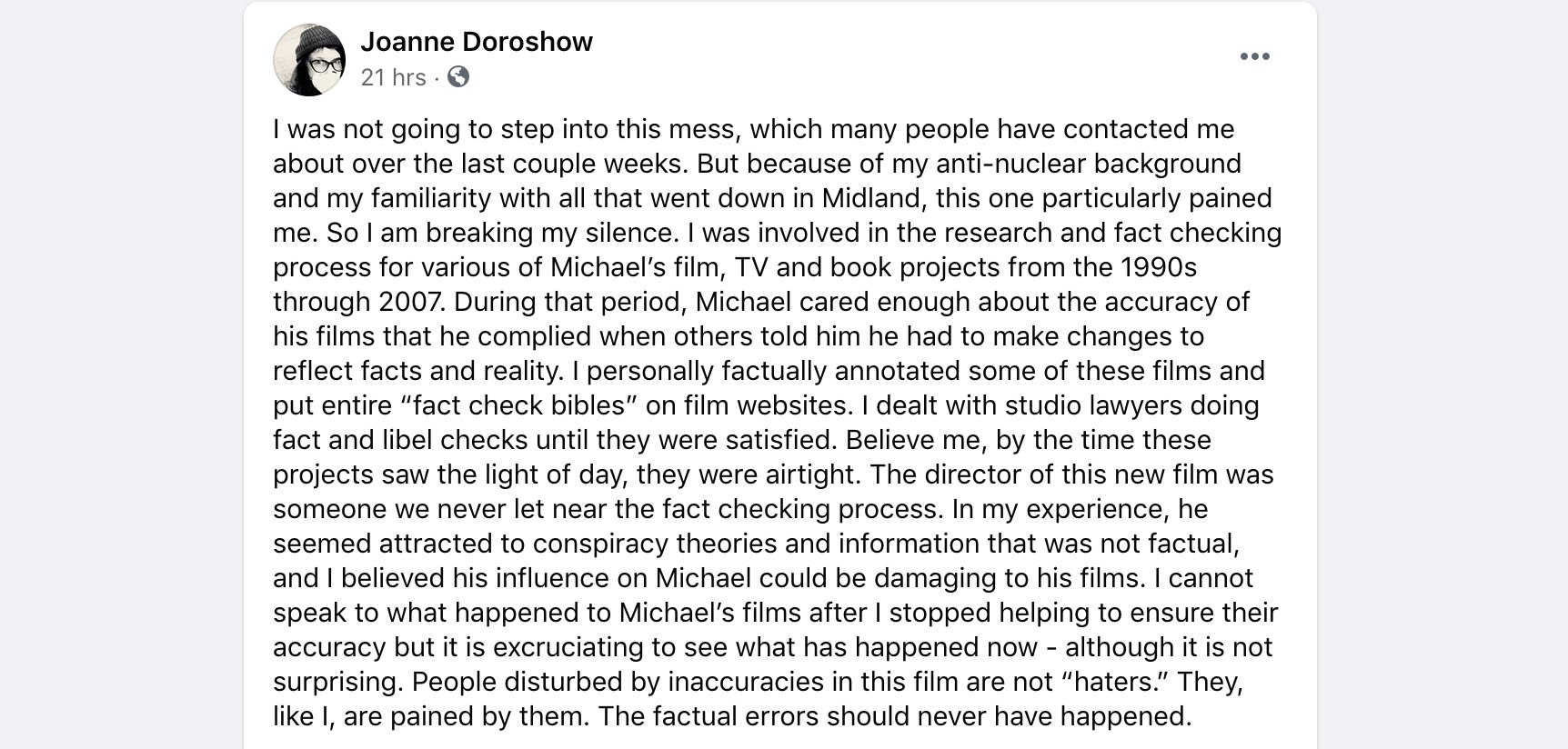
"Watch the film and decide for yourself."
I agree with this statement in principle because we shouldn't let reviews tell us what to think. But we also shouldn't let the film tell us what to think, without reading any of the reviews. To me, they go hand in hand.
The film is one perspective. Each review contains another perspective. Since no one has 100% of the truth, my approach to these issues is to seek out a healthy diversity of perspectives.
It's for this reason that I don't recommend coming to any conclusions after watching the film (or reading a single review).
I've learned so much from reading all the reviews above. At this point, the film was a springboard, but everything since has been the real deep dive.
So Where Do We Go From Here?
No matter what you thought of the film, perhaps there is one thing we can all agree on:
Our industrial civilization (predicated on infinite growth and built upon a once-in-a-lifetime supply of cheap fossil fuels) cannot be sustained.
We're like a plane 10,000 feet in the air and our engines are about to blow out. How can we make a controlled descent? How can we power-down our civilization to thrive at vastly lower consumption and energy levels?
Here are 22 films that tell me "it's not all hopeless."
To be clear, if saving civilization as it exists was the goal, then it's true, the future is looking bleak.
But for billions around the world, civilization, as it exists, is the problem and is not worth saving. Just ask any of the indigenous cultures who are still resisting the bulldozers of our civilization's daily expansion, for a little 'big picture' perspective on that.
Our task is to imagine and design an ecological civilization that can thrive at vastly lower energy and consumption levels - a civilization based not on the old paradigm of "sustainable development" but on ecological regeneration - where the human presence on the Earth generates higher and higher levels of biodiversity and ecological health.
These films point us in the direction we need to go.
 109 min
|
|
 79 min
|
|
 65 min
|
|
 31 min
|
|
 92 min
|
|
 24 min
|
|
 96 min
|
|
 30 min
|
|
 40 min
|
|
 104 min
|
|
 3 min
3 min
|
|
 60 min
|
|
 52 min
|
|
 48 min
|
|
 44 min
|
|
 66 min
|
|
 22 min
|
|
 30 min
|
|
 86 min
|
|
 68 min
|
|
 18 min
|
|
Tim Hjersted is the director and co-founder of Films For Action
SUPPORT OUR WORK
We have no big donors and we don't run on ads. Help us by committing $5 a month.
Subscribe here.