A comprehensive look at the evidence tell us criticism of Chomsky is absolutely warranted. This piece attempts to model what a fair and proportionate accountability process looks like.
Image: Noam Chomsky with Jeffrey Epstein during a flight with Chomsky's wife to visit Woody Allen and others for dinner in 2015.
Last updated 2/17/26
(I welcome your comments on Substack)
The recent release of emails and documents revealing new details about Noam Chomsky’s relationship with Jeffrey Epstein has sparked controversy across the political spectrum.
What follows is a comprehensive review of the documentary record: the emails, the financial entanglements, the letter of recommendation, Valéria Chomsky’s February 2026 statement, and Chris Hedges’ response — alongside a broader examination of what this controversy reveals about how the left handles accountability, disagreement, and the tension between proportional judgment and moral clarity. What I’m attempting here is not a defense of Chomsky but a model for what fair accountability looks like — for him, and for anyone in our movements.
Far more is at stake here than Chomsky's legacy. It is about our ability to build strong movements.
Table of Contents:
The Facts of the Relationship
The Letter of Recommendation
The “Advice” Email
What Chomsky Actually Knew
“He Knew Epstein Was a Registered Sex Offender”
What the Record Doesn’t Show
Steve Bannon & The Old School Principle of Talking to Everyone
The Political Function of This Scandal
Here’s Where I Land
Chris Hedges Responds
In Defense of Reasoned Disagreement
Against Hero Worship
The Facts of the Relationship
Let’s begin by establishing what the documentary record actually shows. According to emails and documents released by the House Oversight Committee, Chomsky and his wife Valéria were introduced to Epstein in 2015 “during one of Noam’s professional events,” according to Valéria Chomsky’s February 2026 statement. However, a letter attributed to Chomsky and found in Epstein’s files—likely written in 2017 or later, when Chomsky was at the University of Arizona—states that he met Epstein “about six years prior” and had “regular contact since,” which would point to roughly 2011. This discrepancy may reflect the difference between a brief initial introduction and the beginning of substantive correspondence—or simply the imprecision of memory.
What is clear from the correspondence is that from roughly 2015 through early 2019, they maintained periodic contact, discussing topics ranging from global finance and artificial intelligence to Middle Eastern politics and linguistics.
The documents also describe Epstein acting as a facilitator. Epstein reportedly arranged a call with a Norwegian diplomat involved in the Oslo Accords and helped arrange a meeting with former Israeli prime minister Ehud Barak, a figure Chomsky had written about critically. Epstein also offered Chomsky access to his residences in New York and New Mexico.
The association went beyond professional contact. As Valéria writes in her statement:
“We had lunch, at Epstein’s ranch, once, in connection with a professional event; we attended dinners at his townhouse in Manhattan and stayed a few times in an apartment he offered when we visited New York City. We also visited Epstein’s Paris apartment one afternoon for the occasion of a work trip. In all cases, these visits were related to Noam’s professional commitments. We never went to his island or knew about anything that happened there.”
She adds:
“We attended social meetings, lunches, and dinners where Epstein was present and academic matters were discussed. We never witnessed any inappropriate, criminal, or reproachable behavior from Epstein or others. At no time did we see children or underage individuals present.”
On the question of how the relationship began, Valéria describes what amounts to a deliberate courtship:
“When we were introduced to Epstein, he presented himself as a philanthropist of science and a financial expert. By presenting himself this way, Epstein gained Noam’s attention, and they began corresponding. Unknowingly, we opened a door to a Trojan horse. Epstein began to encircle Noam, sending gifts and creating opportunities for interesting discussions in areas Noam has been working on extensively.”
There was also a financial dimension to the relationship. In March 2018, approximately $270,000 was transferred to Chomsky from an account associated with Epstein. Valéria’s statement clarifies:
“These were entirely Noam’s own funds. At the time, Noam had identified inconsistencies in his retirement resources that threatened his economic independence and caused him great distress. Epstein offered technical assistance to resolve this specific situation.”
She adds that “Epstein acted solely as a financial advisor for this specific matter” and that “Noam and I never had any investments with Epstein or his office—individually or as a couple.”
Valéria also reveals a previously unknown $20,000 payment:
“Epstein asked Noam to develop a linguistic challenge that Epstein wished to establish as a regular prize. Noam worked on it, and Epstein sent a check for US$20,000 as payment.”
The email record and Valéria’s own description of Epstein as “a very dear friend” in a 2019 email to Steve Bannon suggests the relationship went beyond a purely professional or transactional association—though as one careful reader of the full email archive observed “the entire relationship develops around two trusts” that Noam had set up with his first wife Carol, and the painful family dispute that followed her death.
In this reading, Epstein’s helpfulness during what Chomsky described as “the worst thing that’s ever happened to me”—a bitter financial conflict with his own children over inheritance—explains much of the apparent warmth. Epstein was, by multiple accounts, “extremely helpful” throughout this crisis, and “the occasional dinners and side conversations are marginal in comparison to financial matters.”
This doesn’t excuse the association, but it provides important context for understanding how Epstein—who spent millions cultivating relationships with academics and public figures—was able to embed himself in Chomsky’s life at a moment of profound personal vulnerability. It also gives context to the emails that reveal Chomsky and his wife considered Epstein a real friend.
The Letter of Recommendation
One of the most discussed documents in the release is an undated letter addressed “To whom it may concern” that praises Epstein effusively, describing his “limitless curiosity, extensive knowledge, penetrating insights, and thoughtful appraisals” and calling him “a highly valued friend and regular source of intellectual exchange and stimulation.”
When this letter first surfaced, many—including Greg Grandin in The Nation, Norman Finkelstein, Jennifer Loewenstein, and myself—questioned its authenticity, noting the absence of a signature, university letterhead, or any record of Chomsky sending it, and suggesting the language didn’t sound like him.
Valéria’s statement, however, confirms that Chomsky did write it:
“Epstein proposed meetings between Noam and figures that Noam had interest in, due to their different perspectives on themes related to Noam’s work and thought. It was in this academic context that Noam wrote a letter of recommendation.”
The letter is disappointing, though Valéria’s framing suggests it was written as a professional courtesy within what Chomsky understood to be an academic context. It remains an example of precisely the kind of poor judgment this article as a whole explores—the willingness to extend generosity and trust without sufficient scrutiny.
The “Advice” Email (February 2019)
The most troubling revelation from the newly released files is an exchange from February 23, 2019—three months after the Miami Herald published Julie K. Brown’s exposé detailing how Epstein had operated a transatlantic sex trafficking network targeting children and young girls. In this exchange, Epstein wrote to Chomsky asking for advice on handling his “putrid press,” which was “spiralling out of control.”
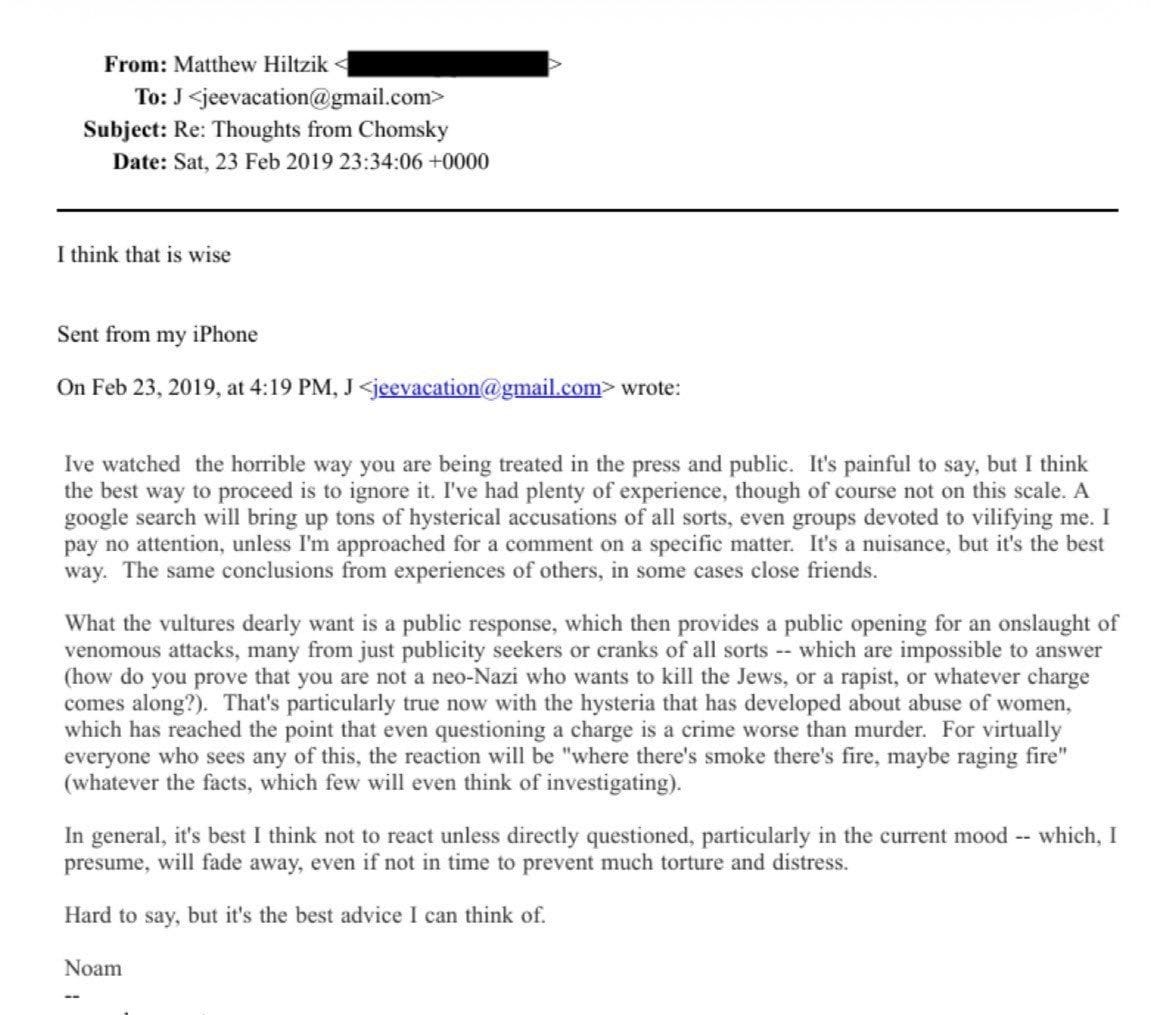
As Greg Grandin reports in The Nation, Chomsky responded the same day, sympathetically. He urged Epstein to ignore the news and not to comment. Chomsky’s response referenced his own experience dealing with public vilification: “A google search will bring up tons of hysterical accusations of all sorts, even groups devoted to vilifying me… venomous attacks, many from just publicity seekers or cranks of all sorts.” He then referenced #MeToo and “the hysteria that has developed about abuse of women, which has reached the point that even questioning a charge is a crime worse than murder.”
This is, to put it plainly, awful to read.
Even under the most charitable interpretation, Chomsky was treating the well-documented accusations against a sex trafficker as analogous to the bad-faith political smears he’d endured throughout his own career. The comparison is stomach-churning—and it represents a profound failure of the moral imagination Chomsky spent his career applying to geopolitics.
Valéria addresses this directly in her statement:
“Epstein had claimed to Noam that he [Epstein] was being unfairly persecuted, and Noam spoke from his own experience in political controversies with the media. Epstein created a manipulative narrative about his case, which Noam, in good faith, believed in.”
She adds an important clarification:
“Noam’s criticism was never directed at the women’s movement; on the contrary, he has always supported gender equity and women’s rights. What happened was that Epstein took advantage of Noam’s public criticism towards what came to be known as ‘cancel culture’ to present himself as a victim of it.”
There is some supporting evidence for this framing.
In late 2018, Epstein sent Chomsky a draft op‑ed giving a detailed, lawyerly defense of his 2008 case, arguing among other things that state prosecutors had weighed “exculpatory evidence, including sworn testimony from many that they lied about being eighteen years old.” Chomsky replied that this was “a powerful and convincing statement.”
In other words, Epstein gave Chomsky a version of events that played directly to his existing biases—and Chomsky bought it. As Valéria writes:
“One of Noam’s characteristics is to believe in the good faith of people. Noam’s overly trusting nature, in this specific case, led to severe poor judgment on both our parts.”
This doesn’t excuse Chomsky’s response, but it does help explain how it happened. A man who spent decades scrutinizing state power and media narratives was susceptible to having those same instincts weaponized against him by a skilled manipulator. As Grandin observes, Chomsky “reflexively treats emotionally wrenching matters as if they can be defused through adherence to abstract principles.”
With Faurisson, it was free speech. With Epstein, it was due process and the presumption of unfair persecution. In both cases, the rigid application of principle blinded him to the moral stakes.
It’s also worth noting that Chomsky’s record on these issues is more complicated than the 2019 email alone suggests. In interviews, he has spoken forcefully against pornography as “humiliation and degradation of women,” comparing it to sweatshop labor and child abuse.
When an interviewer asked how the conditions of pornography should be improved, Chomsky replied:
“Just like child abuse, you don’t want to make it better child abuse, you want to stop child abuse. Suppose there’s a starving child in the slums, and you say ‘well, I’ll give you food if you’ll let me abuse you’... is that an argument? The answer to that is stop the conditions in which the child is starving, and the same is true here. Eliminate the conditions in which women can’t get decent jobs, not permit abusive and destructive behavior.”
He has said of the #MeToo movement that it “grows out of a real and serious and deep problem of social pathology” that “has exposed it and brought it to attention,” while cautioning about “confusing allegation with demonstrated action.”
These are not the views of someone indifferent to the exploitation of women—but they are the views of someone whose rigid commitment to procedural principle could be exploited by a sophisticated predator.
The best-faith reading is that Chomsky was in genuine denial about the accusations, seeing them through the prism of his own experience with decades of bad-faith smears. His close friendship with Lawrence Krauss—a physicist who faced sexual harassment allegations—may have further reinforced his instinct to be skeptical of such accusations within his social circle. But his total lack of empathy in the email, and his flippant dismissal of what the Miami Herald had by that point thoroughly documented, warrants serious criticism.
His later correspondence suggests he did eventually acknowledge the gravity of Epstein’s crimes (discussed in the next section). But his refusal to publicly denounce Epstein, even after the full scope of the crimes became clear, and the defensive posture he and Valéria maintained until her February 2026 statement, has already burned through a great deal of the good will he once had among millions.
In fairness, Chomsky’s silence on Epstein is consistent with a lifelong pattern. As he wrote in one exchange:
“I don’t recall a statement ever denouncing anyone, even the worst mass murderers. When the question comes up I condemn the crimes—though usually I am reluctant to hop on bandwagons and join the crowd. Nixon was a monster, but when it became fashionable to denounce him, I didn’t join.”
The Chomsky family was also famously private—Noam and Valéria consistently guarded their personal lives and rarely engaged with public controversies on a personal level. These are understandable traits in context, but context is something the vast majority of people will never dig deep enough to find. Most will see the headlines, the photo on the plane, the “hysteria” quote—and draw reasonable conclusions from incomplete information. That’s a consequence Chomsky brought on himself, however unintentionally.
To what degree Valéria’s explanation will work to restore that good will, time will tell.
What Chomsky Actually Knew
The central question is what Chomsky knew, and when. Here the record presents a genuine tension.
Valéria’s statement claims they were unaware of Epstein’s 2008 conviction until the Miami Herald’s November 2018 investigation:
“Noam and I were introduced to Epstein at the same time, during one of Noam’s professional events in 2015, when Epstein’s 2008 conviction in the State of Florida was known by very few people, while most of the public – including Noam and I – was unaware of it.”
But when Chomsky was asked about his relationship with Epstein in 2023, he told The Wall Street Journal:
“Like all of those in Cambridge who met and knew him, we knew that he had been convicted and served his time, which means that he re-enters society under prevailing norms — which, it is true, are rejected by the far right in the US and sometimes by unscrupulous employers… I’ve had no pause about close friends who spent many years in prison, and were released. That’s quite normal in free societies.”
These two accounts are difficult to fully reconcile. It’s possible Chomsky learned of the conviction at some point between 2015 and 2018 without it registering as disqualifying. It’s also possible Valéria’s recollection—written three years after his stroke—reflects an honest reconstruction rather than a precise timeline. What seems clear is that by the time Chomsky gave advice to Epstein in February 2019, he was aware of both the conviction and the Herald’s reporting, yet remained skeptical of the accusations.
Since first publishing this piece, a reader forwarded an email exchange he had with Chomsky about Epstein, shared here with permission. Chomsky’s response, dated May 4, 2023, provides important insight into his reasoning:
“There’s an old principle, particularly on the left but much more broadly, that someone who has served a sentence re-enters society without prejudice. One close friend spent years in prison. Epstein was well-known in Cambridge, taking part in scientific conferences in Nowak’s lab, meeting people, bringing important scientists and mathematicians to the meetings. It was well-known that he’d served his sentence. I don’t recall anyone even mentioning it.
Much later, after his incarceration, a flood of lurid stories and charges came out. But no one who knew him, Valeria and me included, ever [heard] or saw a remote hint of anything like that, and all were quite shocked, sometimes skeptical because he was so remote from anything they’d ever heard of.”
As Jennifer Loewenstein has explained, the general public during 2008-2017 knew only that Epstein had been convicted of solicitation of prostitution and procurement of a minor for prostitution, and served 13 months. What they didn’t know was that behind this lenient arrangement was a secret sweetheart deal, and that the victims’ evidence had been “effectively dismissed by higher-ups in Florida and Washington.”
Research into the media record during this period supports the claim that the New York Times—Chomsky’s primary newspaper—largely whitewashed and suppressed the story of Epstein’s rigged prison sentence, despite extensive reporting in the local Palm Beach Post. MIT faculty who interacted with Epstein similarly did not disclose his criminal record when accepting donations, which facilitated the initial connections.
The full extent of Epstein’s sex trafficking operation and the systematic nature of his abuse of children only became widely known after the Miami Herald’s November 2018 investigation by Julie K. Brown, which led to Epstein’s 2019 arrest on federal sex trafficking charges.
“He Knew Epstein Was a Registered Sex Offender”
One of the most common and understandable criticisms I’ve received since first publishing this piece is: “Chomsky knew Epstein was a convicted sex offender and didn’t care. He associated with him anyway. That alone is disqualifying.”
The timeline is complicated by the tension between Valéria’s claim that they were unaware of the 2008 conviction until 2018 and Chomsky’s own 2023 statements suggesting he did know.
What is clear is that by late 2018, Chomsky was maintaining the relationship with full knowledge of the broader accusations — and that at some point, whether early or late, he made a conscious choice not to cut ties with a man who had served time for soliciting a minor.
In response, Chomsky’s critics suggest there’s only one obvious moral stance, and that those who choose otherwise must not care about victims or, worse, condone such behavior. But the question it raises—what obligations we have toward people who’ve served their sentences—reveal legitimate disagreements in society that reflect differing views on punitive versus restorative justice.
View 1: Certain crimes—particularly sex crimes—warrant permanent social exile regardless of legal consequences served. Association with such individuals, even years after release, reflects moral failure, indifference to victims, or social acceptance of their crimes.
View 2: People who serve court-ordered sentences deserve a path back to civil society. Permanent exile creates a permanent underclass and undermines any notion of rehabilitation. This principle applies even when we find the crime abhorrent, because the goal is to support reintegration.
Chomsky has consistently held View 2. And it is worth noting that research on sex offender recidivism actually supports the idea that “positive social relationships actually lower recidivism rates,” and that “familial relationships and social support have greater power over human behavior than sanctions, restrictions, and punishments.”
In the same 2023 email exchange provided to me by a reader, Chomsky spoke to his support of View 2:
“It used to be a truism on the left that all of us have the potential to be saints or sinners. It’s not an innate disposition. Circumstances, upbringing, social norms, all sorts of things enter into good and bad behavior. That’s why the left always stressed the need for efforts for rehabilitation. By now it’s virtually gone. In the US at least.”
From this perspective, abandoning the principle because it catastrophically failed in one case means accepting permanent exile for entire categories of offenders—regardless of what work they’ve done toward genuine accountability.
Critics counter that someone who spent a career scrutinizing how power protects itself should have been more skeptical when encountering a wealthy financier with a sex offense conviction.
That’s a fair point. But it's also worth remembering how these relationships develop. Chomsky didn't seek out Epstein — Epstein sought him out, through the academic circles he was spending millions to infiltrate. Professional contact became familiarity, familiarity became friendship, and repeated exposure to someone who appeared respectable in every institutional setting Chomsky encountered him in would naturally lower skepticism over time.
Valéria, in her statement, acknowledges as much:
“We were careless in not thoroughly researching his background. This was a grave mistake, and for that lapse in judgment, I apologize on behalf of both of us. Noam shared with me, before his stroke, that he felt the same way.”
She adds:
“In 2023, Noam’s initial public response to inquiries about Epstein failed to adequately acknowledge the gravity of Epstein’s crimes and the enduring pain of his victims, primarily because Noam took it as obvious that he condemned such crimes. However, a firm and explicit stance on such matters is always required.”
Reasonable people can disagree about whether the reintegration principle should apply to sex offenders and whether Chomsky applied it with sufficient scrutiny. What the evidence doesn’t support, regardless of which view one holds, is the claim that Chomsky was knowingly complicit in Epstein’s crimes.
A Question of Proportion
Did Epstein deserve harsher consequences than his 2008 sweetheart plea deal? He absolutely did, and his subsequent crimes warranted life in prison. The failure of prosecutors to charge him appropriately represents a massive injustice to his victims. The same goes for Epstein’s numerous redacted co-conspirators and clients, which to this day remain protected and unprosecuted.
But here’s the central question: Should Chomsky be condemned for associating with Epstein during a period when Epstein was not yet a social pariah, when numerous faculty and staff at MIT were using his financial services, when he was still being invited to academic conferences and hosting dinners with scientists and intellectuals, and when the full scope of his crimes remained sealed from public view?
Bill Gates met with Epstein repeatedly after his conviction, even staying at his mansion. Dozens of academics and scientists accepted his funding and attended his gatherings. MIT’s Media Lab took his donations and hosted him for nine visits between 2013 and 2017, while Harvard gave him a personal office, a key card, and hosted him for more than 40 documented visits.
Collectively, hundreds of men and women in respected academic circles associated with Epstein, post-2008 conviction. Yet the media treatment of these associations has largely been “errors in judgment” or “unfortunate lapses.”
Chomsky, by contrast, faces calls for wholesale delegitimization of his life’s work—a response his longtime friends and colleagues find both wholly disproportionate and disconnected from the facts.
We should remember that Epstein’s public legitimacy depended on appearing reformed, credible and respectable in the circles Chomsky frequented. That’s no doubt why Epstein would have focused on building relationships with Chomsky and other luminary figures and diplomats, to insulate him from potential scrutiny.
As Valéria writes:
“It is now clear that it was all orchestrated, having as, at least, one of Epstein’s intentions to try to have someone like Noam repairing Epstein’s reputation by association.”
[…]
“It was deeply disturbing for both of us to realize we had engaged with someone who presented as a helpful friend but led a hidden life of criminal, inhumane, and perverted acts.”
What the Record Doesn’t Show
Here’s what the evidence doesn’t establish:
- Any victim testimony implicating Chomsky
- Any evidence Chomsky knew about or participated in Epstein’s sex crimes
- Any evidence Chomsky received money directly from Epstein (the $270,000 was his own funds; the $20,000 was payment for work)
- Any evidence Chomsky was at locations where abuse occurred
- Any evidence Chomsky provided material support for Epstein’s criminal activities
Steve Bannon & The Old School Principle of Talking to Everyone
When asked if he regretted his association with Epstein, Chomsky responded:
“I’ve met [all] sorts of people, including major war criminals. I don’t regret having met any of them.”
Critics have rightly noted that Chomsky didn’t treat Epstein as a criminal to be studied, but as a friend. That’s true. But the question was whether Chomsky regretted the association, and his answer was no—because he doesn’t regret meeting anyone.
This principle can be seen throughout his life.
As Grandin writes in The Nation, Chomsky “earned a reputation early in his career as someone whose door was always open—who talked to anyone who knocked and answered any letter delivered.” When email arrived at MIT in the mid-1980s, “the stream of letters Chomsky received was largely replaced by a torrent of e-mails. But Chomsky’s open-door policy continued. He still felt obligated to answer all, or nearly all, the people who wrote him.”
Norman Finkelstein commented on this:
“It is an incontrovertible fact that Professor Chomsky met and corresponded with everyone. He didn’t discriminate; that was his modus operandi. That disposes of the bulk of the accusations leveled against Professor Chomsky.”
And as Bev Stohl, Chomsky’s office secretary for 24 years, recounted in her memoir, his inability to say no was perhaps his defining personal flaw:
“‘I don’t know why people don’t hear no when I write to them,’ was Noam’s frequent lament... Noam was his own worst enemy when it came to saying no in a clear, concise way to a friend, colleague, or stranger. He had debated William F. Buckley, Jean Piaget, Michel Foucault, and B.F. Skinner without breaking a discernable sweat, but preferred that I be the naysayer, the killjoy to the inquiring public, I think because of his ambivalence. He hated saying no.”
This openness extended across the political spectrum—including Steve Bannon. A photo of Chomsky and Bannon was found in Epstein’s files, and there’s evidence Epstein tried to arrange a Bannon interview with Chomsky for a never-finished documentary meant to rehabilitate Epstein’s image.
This pattern extends further. As one account details, Chomsky maintained a friendship with John Deutch, an MIT colleague who went on to become deputy defense secretary and then director of the CIA. Despite spending his career opposing the very institutions Deutch ran, Chomsky described him as someone who “has more honesty and integrity than anyone I’ve ever met in academic life, or any other life,” adding, “If somebody’s got to be running the CIA, I’m glad it’s him.”
Michael Albert, who has worked alongside Chomsky for decades and co-founded Z Network, commented on Chomsky’s willingness to engage with figures like Bannon:
“He was curious and given the chance he wanted to learn things useful to his work of dismantling lies and violence. When face-to-face, even with the Devil, Noam would be civil. It was his way.”
An astute question to this, I’ve seen, is that if Noam engaged with radioactive figures for research purposes, where are his published findings (about Bannon, for instance)? But from what I’ve learned, Noam didn’t feel obligated to write about every single individual he encountered. Noam was more focused on systems and big picture issues. I think his experiences contributed to his ever evolving understanding of the world, which then fed into his wider work.
“Not long after he was photographed with Steve Bannon,” Greg Grandin writes, “Chomsky gave a speech at Boston’s Old South Church denouncing Bannon as ‘the impresario’ of an ‘ultranationalist, reactionary international’ movement.”
As Michael Albert wrote:
“I am confident that Noam’s hate for sexism, misogyny, racism, exploitation and fascism didn’t lose even a tiny fraction of its passion and clarity due to his ‘time spent with’ Epstein and/or Bannon. Just like his understanding of the American political system didn’t somehow disappear when he said we should vote for the lessor evil in swing states. And just like his compassion for victims of Nazism didn’t diminish when he defended Faurisson’s free speech.”
As Grandin concludes in his well-researched and recommended piece, “Chomsky was not a sentimental member of what Giridharadas calls the ‘Epstein Class.’”
The Political Function of This Scandal
It’s worth asking who benefits from the Chomsky-Epstein scandal. Chomsky has spent his career arguing that American presidents are war criminals, that capitalism is fundamentally exploitative, and that mainstream media manufactures consent for elite interests. He is, in short, a figure the establishment has every reason to want discredited.
The Epstein scandal provides the perfect vehicle: guilt by association dressed up as moral reckoning. It allows critics to avoid engaging with Chomsky’s actual arguments about power, imperialism, and propaganda while casting him as a hypocrite who consorted with the very elites he claimed to oppose.
But this critique fundamentally misunderstands Chomsky’s project.
He has never argued that intellectuals should refuse to speak with powerful people or that we should create a cordon sanitaire around anyone who has committed crimes.
On the contrary, his entire method has been to understand how power works by engaging directly with those who wield it. This has never been a secret. Chomsky spent his entire career straddling two worlds — working at MIT, an institution deeply embedded in the military-industrial complex, while simultaneously being its most forceful critic. He befriended Pentagon scientists while denouncing the systems they served. This wasn't hypocrisy so much as a lifelong habit of separating individuals from the institutions they represented. That habit extended naturally to Epstein — and it failed him. But it also defined a life spent in relentless service to the truth, often at great personal cost.
Few people saw that up close for longer than Bev Stohl, who writes:
As Chomsky’s assistant for 2 ½ decades, I observed his total dedication to humankind. He barely slept, had to be reminded to eat. He was patient with those who didn’t understand, or misinterpreted, his statements, all based on facts. He forged ahead despite detractors, was ethical and honest, working to exhaustion to expose and share truths. […] Now, it’s hard to be silent when I see wild accusations being thrown at such an honest and dedicated man.
Here’s Where I Land
This article has been my attempt to model what a fair and proportionate accountability process might look like for Noam, or any longtime ally to our movements.
I want to say it again: I believe criticism of Chomsky is absolutely warranted.
His lack of a forceful condemnation of Epstein before his stroke is undeniably disappointing.
The February 2019 “advice” email is indefensible in its tone, even if the underlying intent was to counsel a person he believed—naively, wrongly—was being unfairly persecuted. And Valéria’s confirmation that Chomsky wrote the letter of recommendation, in language far more effusive than the relationship warranted, only adds to the picture of poor judgment.
But what I am arguing is that:
1. Whatever one makes of Chomsky’s relationship with Epstein, I don’t believe it should overshadow the monumental contributions he has made to our understanding of power, propaganda, imperialism, and corporate capitalism.
His work has shaped multiple generations of scholars, activists, and journalists. These contributions don’t evaporate because he acted according to principles he’s held throughout his life.
2. The evidence released thus far does not implicate Chomsky or his wife in Epstein’s crimes or suggest they had knowledge of Epstein’s predatory behavior during their association.
3. Valéria’s statement—which acknowledges “severe poor judgment on both our parts,” apologizes for their “grave mistake,” and expresses “unrestricted solidarity with the victims”—represents the kind of honest reckoning that has been missing from this story.
4. There is no evidence Chomsky saw Epstein's crimes as "not a big deal." What the evidence shows is something more common and in some ways more troubling — a man who trusted a friend's account over the accusers', who applied rigorous skepticism to every powerful institution he encountered but not to the powerful individual in his own life.
5. We can debate and critique Chomsky’s association with Epstein—and his genuinely troubling February 2019 email—without participating in what is essentially a politically motivated smear campaign.
6. Aside from his disastrous failure of judgment with Epstein, even as the evidence piled up, his defensive public response was an entirely self-inflicted wound, which Valéria has since acknowledged.
But that said, I don’t want to put his legacy on a pedestal or in the grave.
If we insist our intellectual heroes be completely free from any serious mistakes, poor judgment calls, or ethical blind spots—we will have few heroes left, and find ourselves constantly disappointed. This standard also serves power perfectly: it ensures the public constantly purges its most effective voices over human fallibility while establishment figures face no comparable scrutiny.
Chomsky has spent seven decades doing work most of us will never approach—documenting atrocities, exposing propaganda systems, standing against empire when it was deeply unpopular. We can hold complexity: acknowledging Chomsky’s failures while refusing to participate in his delegitimization. The alternative—treating any flaw as disqualifying—leaves us with few to learn from and no capacity to build the movements we desperately need.
7. Part of what inspired me to write this article goes far beyond Chomsky. It is about the health of our movements and how we navigate tension and accountability for those that have made serious mistakes.
This rush to discard movement leaders (or anyone in the struggle) over flawed judgments, serious mistakes or legitimate differences in perspective is not a new pattern on the left.
Bernie Sanders has also been called a “sellout” and a “traitor” for endorsing Hillary Clinton and Joe Biden—strategic choices aimed at preventing worse outcomes. On the other end, Dr. Cornel West, long beloved by the left, was dismissed by many for running third party. Jill Stein is still exiled by millions for her choices. Kshama Sawant and others are rejected by many because of their campaign to ensure Kamala Harris lost to Trump as punishment for supporting the genocide in Gaza. I saw their campaign as an understandable but catastrophic strategic mistake, with immense consequences, but I still see her as a sister in the struggle, and Chomsky has been condemned for all number of statements and positions he’s made over his lifetime. I have strong disagreements with all of them, but I still consider them brothers and sisters in the struggle. As a student of Thich Nhat Hanh for 20 years, that is just my disposition.
In my view, the left’s circular firing squad tendency too often treats any moral failure, legitimate disagreement or tactical compromise (or lack of it) within unjust systems as grounds for complete dismissal, erasing decades of contribution with alarming speed. This asymmetry of focus and attention isn’t accidental. It’s easier to tear down our own than to sustain the difficult work of building power against entrenched interests.
Chris Hedges Responds (Feb 8, 2026)
Chris Hedges, writing in response to Valéria Chomsky’s statement, offered what may be the most damning assessment from someone who genuinely admires Chomsky:
“I know and have long admired Noam. He is, arguably, our greatest and most principled intellectual.
I can assure you he is not as passive or gullible as his wife claims. He knew about Epstein’s abuse of children. They all knew. And like others in the Epstein orbit, he did not care.
From the email correspondence between Epstein and Valéria it appears she particularly enjoyed the privileges that came with being in Epstein’s circle, but this does not absolve Noam’s acquiescence.
Noam, of all people, knows the predatory nature of the ruling class and the cruelty of capitalists, where the vulnerable, especially girls and women, are commodified as objects to be used and exploited. He was not fooled by Epstein. He was seduced. His association with Epstein is a terrible and, to many, unforgivable stain. It irreparably tarnishes his legacy.
If there is a lesson here, it is this. The ruling class offers nothing without expecting something in return. The closer you get to these vampires the more you become enslaved. Our role is not to socialize with them. It is to destroy them.
I greatly respect Hedges. His moral clarity on empire, capitalism, and the predatory nature of the ruling class is legendary — which is why I’m surprised to see him state as fact what can only be speculation at this point.
“He knew about Epstein’s abuse of children. They all knew. And like others in the Epstein orbit, he did not care.”
Hedges doesn't distinguish between knowledge of Epstein's 2008 conviction and the far more serious accusations that emerged in 2018 — two very different things, with very different implications for what Chomsky "knew."
If evidence later proves the latter, I will share Hedges’ assessment fully. But the private leaked emails from late 2018 and early 2019 — emails Chomsky had no reason to think would ever be public — tell a different story.
They show a man who appears to genuinely believe Epstein’s version of events, who dismisses the accusations as “hysteria,” who advises Epstein to ignore the press. That isn't the behavior of someone who knows and doesn't care. It's the behavior of someone who chose the comfort of trusting a friend over the discomfort of questioning him. One of the most important contributions of the #MeToo movement has been showing us how common this choice is — and how much damage it does. Taking accusations seriously enough to actually investigate them, even when they're aimed at people we trust, is the bare minimum. Chomsky, by all available evidence, never did that. It's a grave failure, but a different one than knowing and not caring.
Hedges’ argument rests on the assumption that Chomsky was too brilliant to be fooled. And in hindsight, it’s easy for all of us to say that anyone who associated with Epstein after 2008 should have known better. But intelligence doesn’t inoculate against manipulation — if anything, research in cognitive science suggests it can make someone more vulnerable. As Yale researcher Dan Kahan has shown, people who score highest on reasoning tests are often the most susceptible to ideological bias. Being better at reasoning makes you better at rationalizing.
In Chomsky’s case, a lifetime of being smeared in the press gave him a built-in bias toward dismissing accusations against Epstein — he saw the same pattern of persecution he’d experienced himself and projected it onto Epstein.
There’s also the simple human element. How often do friends of the accused — men and women alike — refuse to believe it? How common is the reflex: “I’m a good person, so there’s no way I’d be friends with someone capable of that”?
This, to me, is the real lesson buried beneath the denunciations — not that Chomsky was uniquely flawed, but that his mistake is not unique at all.
Every survivor of abuse knows this pattern intimately — not being believed, not because the people around them were monsters, but because denial is the default when the accusation hits close to home. Those who say “I would never have been fooled” are creating the very blind spot that likely ensnared Chomsky in the first place. The certainty that you’d recognize a monster when you met one is the thing that stops you from recognizing him. That’s not an excuse for Chomsky. It’s a warning for all of us.
“They all knew” is also the exact guilt-by-association logic this article is arguing against. It collapses every person in Epstein’s orbit into a single category. But we know empirically that isn’t true. Some knew and participated. Some knew and looked away. Some were deceived. Some were being cultivated. Hedges treats proximity to Epstein as proof of a single uniform moral failure, when the evidence shows a spectrum of complicity that demands more careful distinctions than “they all knew” allows.
And notably, Hedges offers no theory for why Chomsky would knowingly associate with a child abuser.
He was “seduced” — but by what?
Money? For a few nights in a Manhattan apartment and a $20,000 linguistics prize, Chomsky risked a legacy he’d spent 70 years building? Financial help? Epstein’s advisory services were useful during a family estate dispute — but the idea that Chomsky knowingly maintained a relationship with a child sex trafficker for the sake of estate planning beggars belief. The risk-reward calculation only makes sense if Chomsky didn’t know — which is the very possibility Hedges dismisses. The word “seduced” does all the work while explaining nothing. A serious accusation requires a serious mechanism, and Hedges doesn’t provide one.
No one risks their entire life’s work for marginal financial convenience — unless they don’t realize they’re risking anything at all.
That said, I respect Hedge’s skepticism. The fact that we can’t know for certain troubles me. This uncertainty alone tarnishes Chomsky’s legacy. But I think it’s important to separate fact from speculation.
Some might argue this standard is naive — that if I’m unwilling to convict Chomsky on circumstantial evidence, I should extend the same grace to everyone in Epstein’s orbit. But epistemic humility doesn’t mean treating all cases as equally ambiguous. Character assessment matters. Context matters. A 70-year record of principled dissent, confirmed by decades of colleagues and friends, creates a different evidentiary baseline than, say, someone with decades of documented predatory behavior, sexual assault allegations, and a pattern of lying about virtually everything. The standard isn’t “never draw conclusions.” The standard is “let the weight of evidence guide the conclusion.” Based on everything I’ve examined in this article, I find the plausible, good faith explanations for Chomsky’s failures more credible.
In Defense of Reasoned Disagreement
The evidence may change. If documents emerge proving Chomsky knew the extent of Epstein’s ongoing crimes and maintained the relationship anyway, I’ll be the first to say Hedges and others were right and I was wrong. But based on what we know now, I don't believe these failures of judgment warrant the blanket condemnation he's faced across the political spectrum.
I respect those that disagree, but in my book, Chomsky is still a legend—human, flaws and all.
His work exposing how elites manufacture consent for the status quo was instrumental in me becoming an activist and co-founding Films For Action.
I’ve never agreed with Chomsky on everything or revered him as infallible, but my respect for him or anyone has never depended on that. Nor Chris Hedges, Amy Goodman, Kshama Sawant, or Bernie Sanders. Nor activists in my community who I often disagree with.
One of the principles I learned from Chomsky’s work was how to engage with ideas I oppose: through reasoned argument rather than moral condemnation, by addressing the strongest version of an opponent’s case rather than caricaturing it, and by maintaining that people can disagree in good faith without being enemies. He modeled this even when dealing with his harshest critics—responding to their arguments rather than attacking their character.
Though a majority appears to appreciate my article, the critical responses so far have varied between thoughtful and harsh. Despite my critiques of Chomsky throughout the piece, my refusal to condemn him wholesale has been met with equally forceful condemnation.
Some critiques are quite uncharitable. Some deliberately misread my argument. Some admit they didn’t read the article at all. Others offer legitimately understandable counterarguments that I respect, which has helped me improve this article and my own thinking.
It’s that last category that matters. There are legitimate disagreements on the left about what Chomsky’s association with Epstein means and whether it’s disqualifying. The same goes for any number of his ideas and positions.
What I object to is the refusal to acknowledge that legitimate disagreement exists at all. The insistence that anyone who weighs this evidence differently must be defending sexual predation, or deserves to be dismissed with the same contempt they reserve for Chomsky himself. That pattern—treating moral complexity as moral failure, demanding unanimous condemnation as proof of virtue—is exactly what I’m critiquing.
It’s an old school ethic, one Chomsky practiced throughout his career, to maintain space for principled disagreement without resorting to character assassination.
We can argue vigorously about all of this — the judgment, the standards, the legacy — and still treat each other as people attempting to navigate complex issues in good faith.
Against Hero Worship
One recurring criticism in left circles dismisses Chomsky as a “poor man’s Michael Parenti,” someone who didn’t lead the revolution, who sold out, who wasn’t radical enough. Similar attacks target Bernie Sanders for working within the Democratic Party, or dismiss any activist who doesn’t meet some imagined purity threshold.
This is ironically its own form of hero worship—just inverted. It assumes the only activists we should respect are those with the most radically uncompromising politics.
But here’s the thing: I’m actually doing the opposite of holding Noam on a pedestal. I don’t expect any single activist, intellectual, or politician to lead us to liberation. That’s not how change works, and placing that burden on individuals sets us up for endless cycles of disappointment and denunciation.
Instead, I appreciate contributions for what they are. Chomsky introduced millions of people to sophisticated critiques of power and manufacturing consent. That’s valuable. Bernie Sanders moved policy conversations leftward and inspired a generation of organizers. That’s valuable. Anarchists blockading pipelines risk their freedom to slow ecological collapse. That’s valuable. None of them are perfect. None of them will save us. All of them contribute something worth building on.
We never needed Chomsky or any movement figure like Michael Parenti, Kshama Sawant, Chris Hedges, Amy Goodman, Bernie Sanders, Cornel West, Alexandria Ocasio-Cortez, or anyone else to be a perfect avatar for our politics.
What we’ve always needed is millions of people to get off the sidelines and into the game, taking the best from these influences, learning from their mistakes and respecting a diversity of perspectives and contributions.
The rush to judge, not just Chomsky, but all of our movement leaders, reflects the same mistake as hero worship—just with the valence flipped. Both approaches treat individuals as either saints or frauds, saviors or sellouts, rather than as humans with mixed records whose work we can learn from while remaining clear-eyed about their limitations.
Real movements need many people contributing in different ways—some writing theory, some organizing unions, some running for office, some engaging in direct action, some building alternative institutions. Demanding that everyone pursue the most radical possible path, or dismissing anyone whose life doesn’t match an imaginary revolutionary ideal, doesn’t build power. It just ensures we keep eating our own while the actual structures of concentrated power remain untouched.
That serves power far more effectively than any of Chomsky’s mistakes ever could.
Tim Hjersted is the director and co-founder of Films For Action, a library dedicated to the people building a more free, regenerative and democratic society.
Subscribe on Substack for updates. You can contact the author here.
SUPPORT INDY MEDIA
Appreciate our work to amplify independent voices? Join us as a $5/month patron.
Subscribe here.