Donald Trump won’t be backing down any time soon on his claims of widespread voter fraud in the 2016 elections. Just weeks after winning the Electoral College, Trump tweeted that millions of illegal voters had cost him the popular vote.
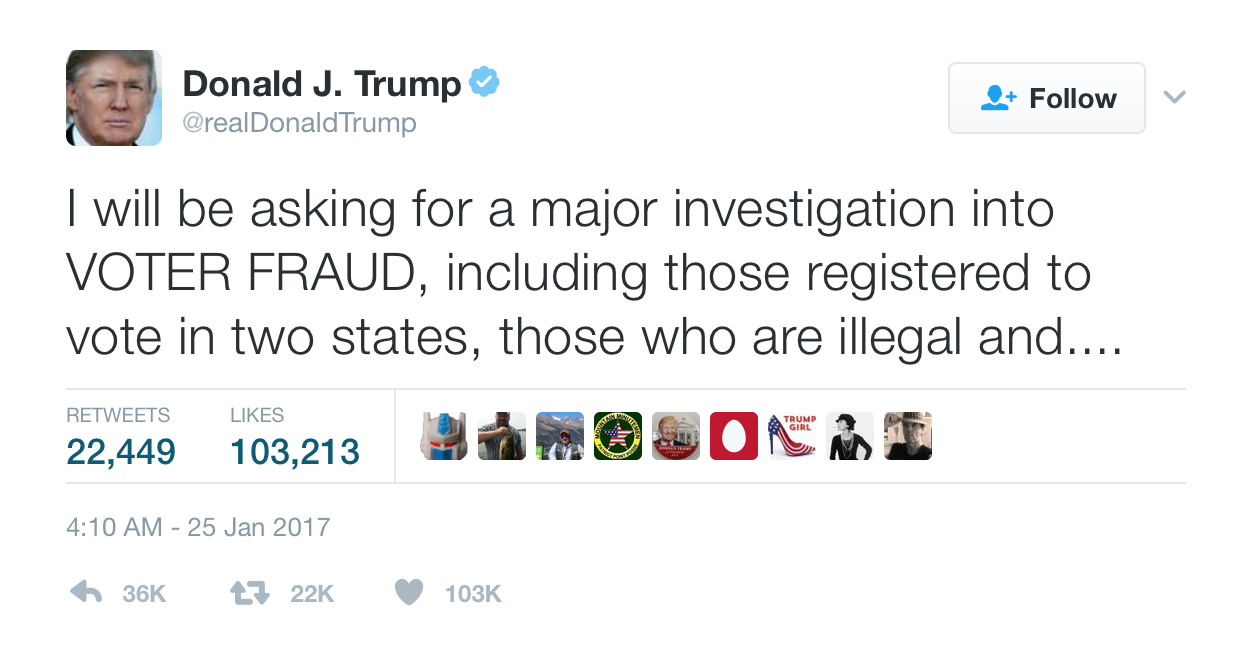
On Tuesday, White House Press Secretary Sean Spicer stood by these claims, “[Trump] continues to maintain that belief based on studies and evidence people have presented to him.” But according to Politico’s Louis Nelson, the only evidence Spicer was able to provide was a Pew study whose author has stated that the research does not support Trump’s claim.
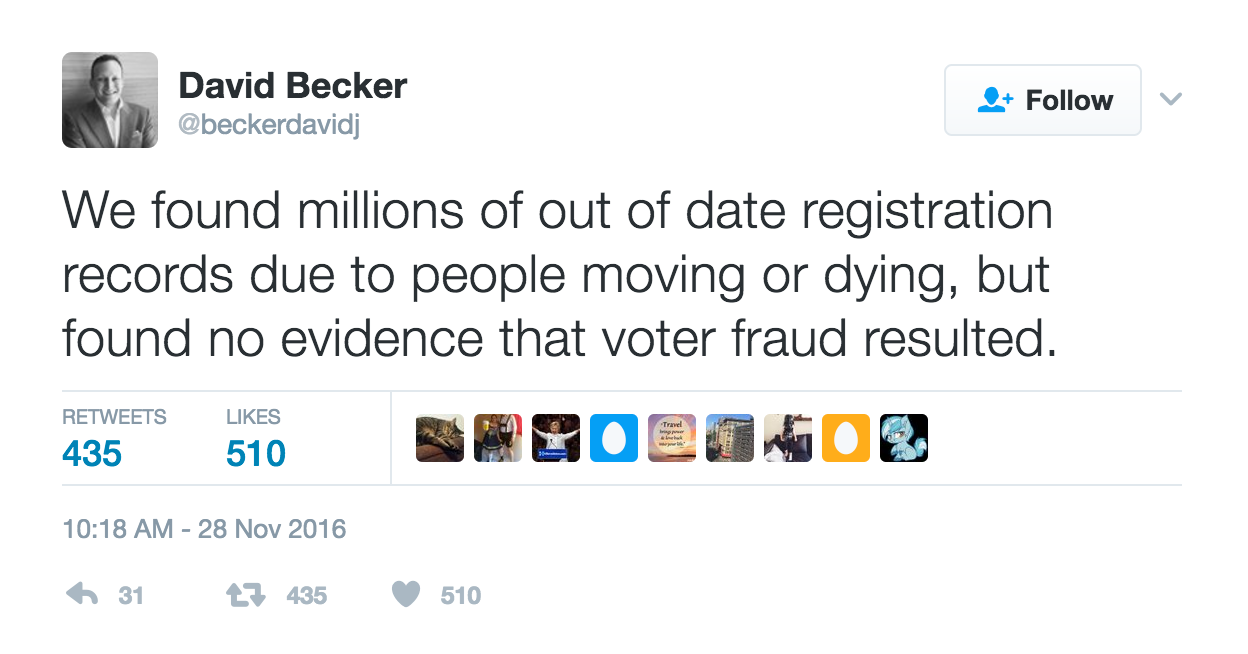
“We found millions of out of date registration records due to people moving or dying, but found no evidence that voter fraud resulted,” David Becker, the Pew study’s author, wrote on Twitter in late November.
On Wednesday, Trump again took to Twitter and promised a ‘major investigation into VOTER FRAUD.’
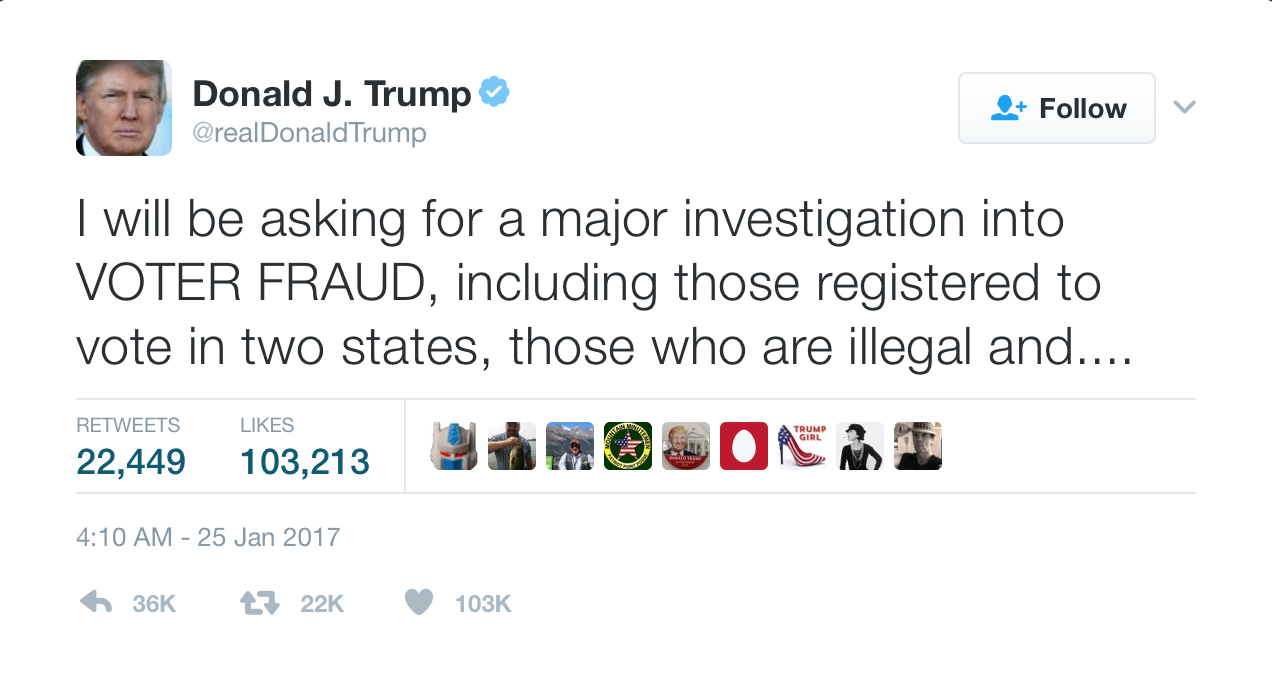
Though Trump won the Electoral College with 304 electoral votes, The New York Times has reported that he lost by a margin of 3 million votes to Hillary Clinton in the popular vote. Many journalists have concluded that these claims of rampant voter fraud are the direct result of a hurt ego. While there may be truth to this, there are certainly other motivations for Trump and the GOP to continue to cry voter fraud in 2017.
The Voting Rights Act was crippled by the Supreme Court’s ruling on Shelby v. Holder (2013). The court found that Section 5 — the formula that decided which states were covered — was unconstitutional and thus making it easier for states to pass new restrictive voting legislation. Since this ruling, we have seen an influx of new restrictive voting laws proposed and passed at the state level. These include voter ID laws, elimination of same day voter registration and early voting, elimination of polling locations, and gerrymandering.
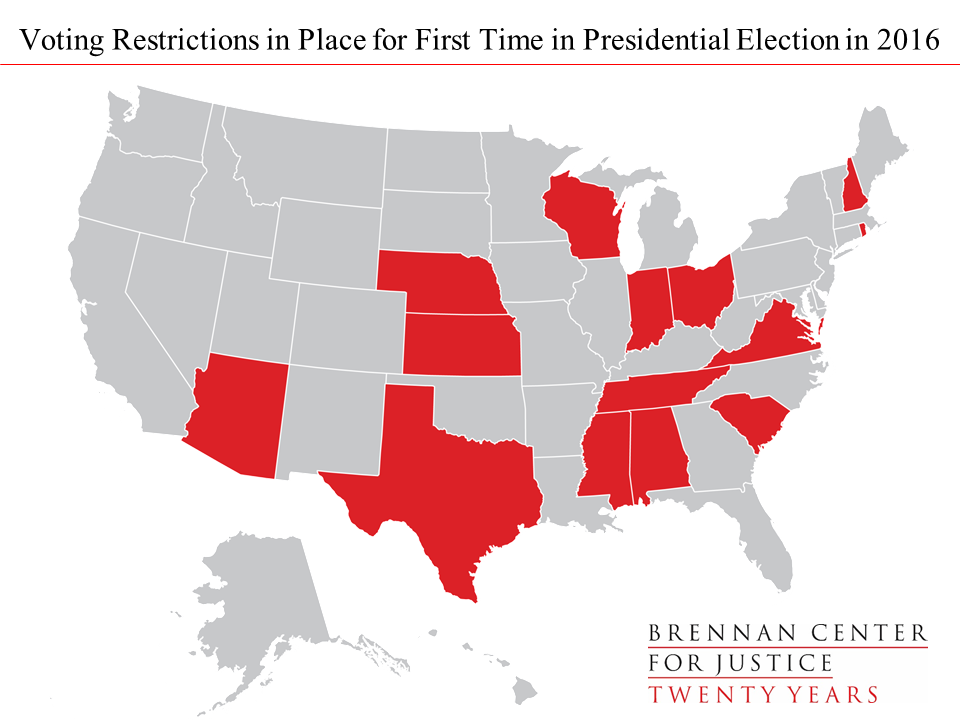
The Brennan Center for Justice reported that voters in 14 states experienced new restrictive voting laws in 2016. What’s even more troubling is that roughly half of the states previously covered by Section 5 of the Voting Rights Act have passed new restrictive voting laws since 2010.
These new laws have all been passed under the guise as a protection against voter fraud, yet there appears to be no credible evidence that widespread voter fraud exists. The Washington Post reports that in the 2016 election, there have been just four documented cases of voter fraud out of 135 million votes cast.
As of November 2016, thirty two states have enacted a voter ID law with the intention to curtail voter impersonation. These voter ID laws range in restrictiveness with seven states requiring photo identification to vote. But the issue of evidence and necessity remains: “As I’ve written over and over, you’re more likely to be struck by lightning than impersonate another voter at the polls,” Ari Berman, Senior Contributing Writer at The Nation. In a separate study by the Washington Post, Justin Levitt, a professor at the Loyola Law School, Los Angeles, found just 31 substantiated cases of voter impersonation fraud out of 1 billion votes cast between 2000 and 2014.
If the evidence doesn’t support the necessity for new laws, why and who is supporting it? A recent study by UCSD found that voter ID laws had a disproportionate effect on Republicans and Democrats. In states with strict voter ID laws, Democratic turnout was reduced by 8.8% while Republican turnout was reduced by 3.6%. This study also found a trend in where these laws were being passed: states with a Republican majority legislature along with a large ethnic minority population were more likely to pass restrictive voter ID laws.
Though we do not have conclusive evidence that the GOP solely supports these laws with the intention to suppress the vote, there have been plenty of instances of lawmakers acknowledging that they help the GOP win elections. In a televised interview with WTMJ-4 leading up to the November 2016 election, Wisconsin Congressman Glenn Rothmans stated, “Now we have photo ID, and I think photo ID is gonna make a little bit of a difference as well.”
As Trump and his administration continue its claims of rampant voter fraud, it will be too easy to critique these as the rantings of an overly sensitive and insecure man. We’ve learned that facts can be replaced with alternative facts — if Trump repeats himself enough times, many will accept it as reality regardless of fact. So it is imperative today that we take these claims of voter fraud as a precursor for more rampant suppressive voting legislation to come.
Watch Brian Jenkins most recent documentary Answering the Call: the American Struggle for the Right to Vote on iTunes, Amazon, Vimeo, or DVD