Part 1: “We Told Y’all Not to Vote for Him"
This two part installment explores the prophetic clarity and emotional weight behind this statement, breaking down its historical, political, and cultural depth.
“We told y’all not to vote for him. At minimum, if you had read the Project 2025 180-Day Playbook, you’d know exactly what you were voting for.”
— A Black Woman's Political Lament, Assertion, and I-Told-You-So
From a Black woman’s perspective, this statement conveys both frustration and vindication. It suggests warning, a strong sense of foresight, and clean accountability. It's often used to signal: “We cautioned against this person—and now that his actions are unfolding, the blame rests squarely on those who bought into it.” When used in current events—like during or after elections—especially involving controversial figures or divisive campaigns, this message resonates because:
It’s topical: Many presidential or local candidates stir racial tensions, impact civil rights, or carry policies with disparate effects on marginalized communities.
It speaks to political foresight: A recognition that past warnings (e.g., “He’s hateful,” “His policies hurt us”) have become reality.
It underscores accountability: You're living the consequences of your civic choices—no excuses.
Broader Implications
Cultural critique: This is more than political—it’s also a critique of collective responsibility. It invites reflection: are we listening to communities that have been warning us?
Empowerment: Rooted in a sense of community vigilance, it positions the speaker as having authority—born from watching, warning, and surviving those warnings.
A reminder: Democracy isn’t a spectator sport. Votes have consequences, and dismissing long-standing warnings often leads to lived harm.
Historical Wisdom and Collective Memory
This statement isn’t just about a single election or a single politician. It carries the weight of generations of warnings ignored. Black women—often seen as the moral compass of American democracy—have long stood at the intersection of racism, sexism, classism, and exploitation. Historically, their political warnings have not been based on abstract theories but on survival instincts and ancestral memory.
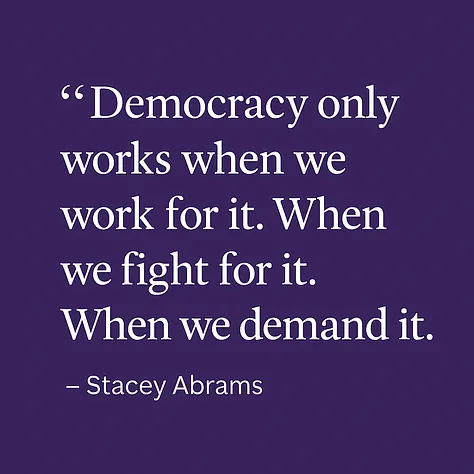
From Fannie Lou Hamer, to Shirley Chisholm, to modern organizers like Stacey Abrams, Black women have warned of the dangers of political apathy, white nationalism, patriarchal politics, and policies cloaked in populism but rooted in oppression.
The “Y’all” Factor – Racial and Political Whiteness
“Y’all” in this phrase is not just a casual colloquialism. It is a strategic indictment—often directed at:
- White voters who voted for a candidate ignoring racism, inequity, and economic injustice.
- Moderate or liberal individuals who believed they could “work with him” or “wait and see.”
- Sometimes even Black or POC voters who were swayed by respectability politics, false promises, or fear.
This “y’all” is confrontational. It forces people to reckon with the fact that they either:
- Voted for harm out of self-interest or willful ignorance.
- Or remained silent and complicit while others were trying to sound the alarm.Emotional Labor and Exhaustion
This phrase is laced with emotional exhaustion.
Black women are often asked to show up—to vote, to organize, to explain, to comfort, to fight, and to forgive—while rarely being heard. This is not just “I told you so” in a smug sense—it’s grief disguised as assertion. It’s the pain of seeing loved ones hurt, rights stripped away, dignity denied—after begging others to listen. It’s the fatigue of warning people who mistake civility for safety and compromise for wisdom.
Political Meaning
“You got exactly what you voted for.”
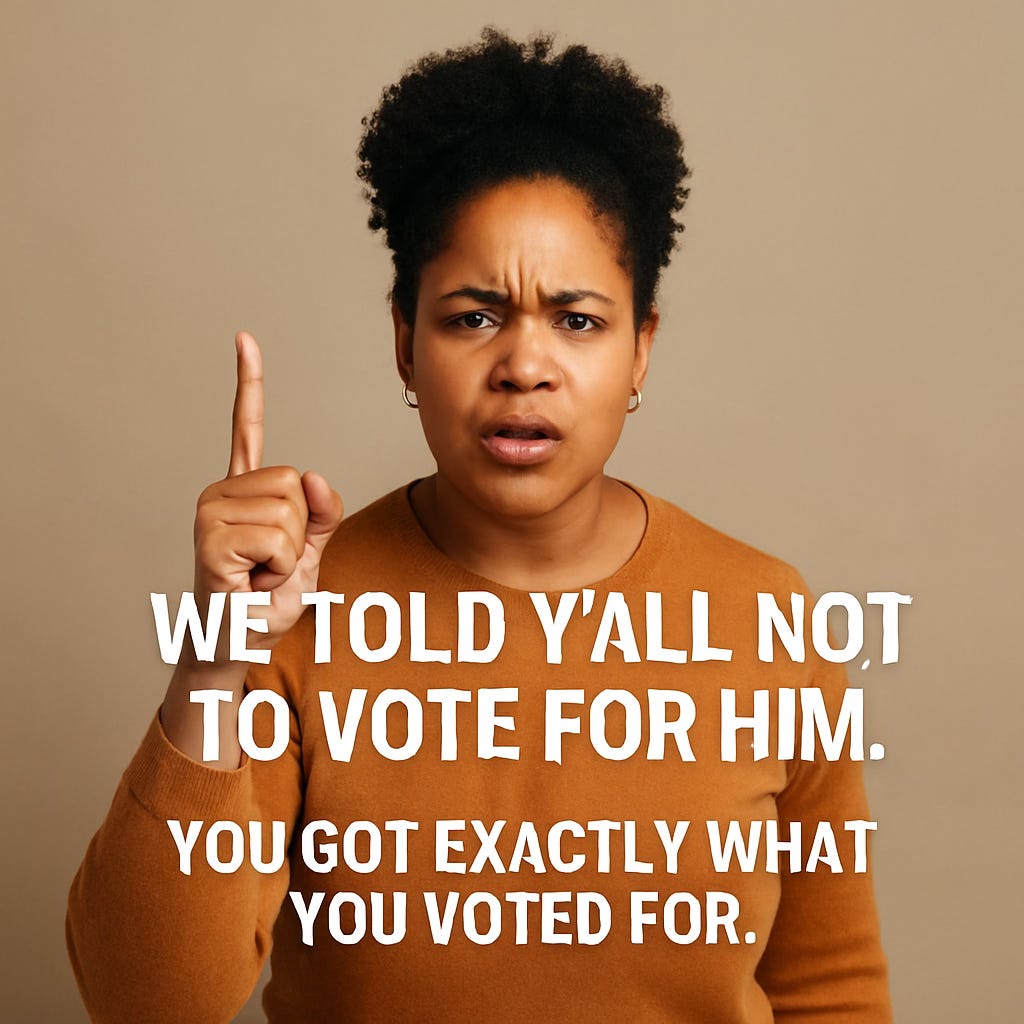
This line lays bare cause and effect, and strips away the luxury of denial and exposes irresponsibility. Project 2025 laid out the Mandate for Leadership in full view—the detailed version (over 900 pages) and the summary version (about 40). If you are reading this article, which version did you examine before casting your vote?
Further, which of the statements below reflects how you ultimately voted?
- Voted for “law and order”? (You got over-policing and mass incarceration.)
- Voted for “economic growth”? (You got tax cuts for billionaires and underfunded schools, and the dismantling of the Department of Education.)
- Voted for “America First”? (You got xenophobia, environmental rollbacks, and global embarrassment.)
This isn’t just rhetorical—it’s a cold reality check. The outcomes aren’t accidents; they’re deliberate consequences of a political ideology many voters chose to empower.
Philosophical and Moral Dimensions
Truth Telling as Radical Love
This message may sound harsh, but it is rooted in a truth-telling tradition that sees warning as a form of care. Black women have often had to be the “conscience of the nation,” not because they were asked—but because no one else would do it. To tell someone the truth—even when it hurts—is a radical act of accountability and justice.
Love without truth is sentimentality. Truth without love is brutality. This phrase threads the needle between both.
The Politics of “I Told You So”
In a white-dominant culture that prizes politeness over truth and comfort over justice, “I told you so” becomes a subversive, necessary declaration. It disrupts the status quo. It names harm. It rejects gaslighting.
It forces a moral and political reckoning:
- Who gets to be right?
- Whose warnings matter?
- Whose foresight was dismissed as fear mongering?
Contemporary Relevance
Whether it’s government officials in the White House, Project 2025, abortion bans, book bans, anti-Black policing, or anti-immigrant policing—this phrase echoes in real time: You got exactly what you voted for…
- As states roll back voting rights.
- As courts chip away bodily autonomy.
- As movements for justice are demonized while white supremacist violence goes unchecked.
- A movement toward authoritarianism and kingship.
We told y”all not to vote for him" becomes a rallying cry for prophetic clarity in the age of political amnesia.
Prophetic Anger, Strategic Clarity
This isn’t about division. It’s about direction. Black women have historically been America’s frontline thinkers, defenders, and democracy-builders. This statement is a declaration that the margin already knew what the center is just now waking up to.
It is a call:
- To listen when Black women speak.
- To trust lived experience over empty slogans.
- To move forward not just with regret, but with a new moral commitment—to act on what you now know to be true.
When Loyalty Replaces Discernment: The Danger of Blind Faith in Leadership
Also at the heart of the message, “We told y’all not to vote for him,” is a deep critique of blind allegiance. Blind faith in any leader is the soil where tyranny grows. Some people didn’t just vote for harm.They worshipped him.
What Black women saw—and tried to warn others about—wasn’t just poor policy or lack of experience. It was a cult of personality. A system of unchecked devotion where:
- Charisma replaced character,
- Spectacle replaced substance,
- And loyalty replaced discernment.
The Seduction of Power Framed as “Anointed”
In American political life—especially among white evangelical voters—there is a long and dangerous tradition of assigning divine significance to political figures. Some called him “God’s chosen.” Others said he was “rough around the edges, but doing the Lord’s work.” Meanwhile, marginalized communities said: This doesn’t look like freedom. It looks like Pharaoh.
Black women, steeped in the tradition of the Black church and the liberation gospel, know the difference between a prophetic voice and a manipulative one. They saw through the false anointing. And they were gaslit for calling it out.
When Faith Becomes a Weapon, Not a Guide
The weaponization of scripture, religious language, and Christian identity was a core tool in rallying support around him—not despite his behavior, but because of it.
- The Bible was held up as a photo op.
- A new political version of a Bible was published (like the missionary Slave Bible published in 1807).
- Political rallies turned into worship services.
- “God” became code for domination, not deliverance.
This isn’t faith—it’s idolatry. And Black women, from Sojourner Truth to modern pastors and activists, have always spoken out against the kind of “faith” that excuses cruelty and calls it leadership.
Discernment Is the True Test of Faith
In the Black prophetic tradition, faith is never blind—it is watchful, wise, and truth-telling. To vote for harm in the name of faith is not just a political failure—it’s a spiritual betrayal.
It is Micah 6:8 faith: “Do justly. Love mercy. Walk humbly.”
It is not the kind of faith that crowns kings.
It is the kind that sets captives free.
Final Reflection: We Told Y’all Not to Vote for Him
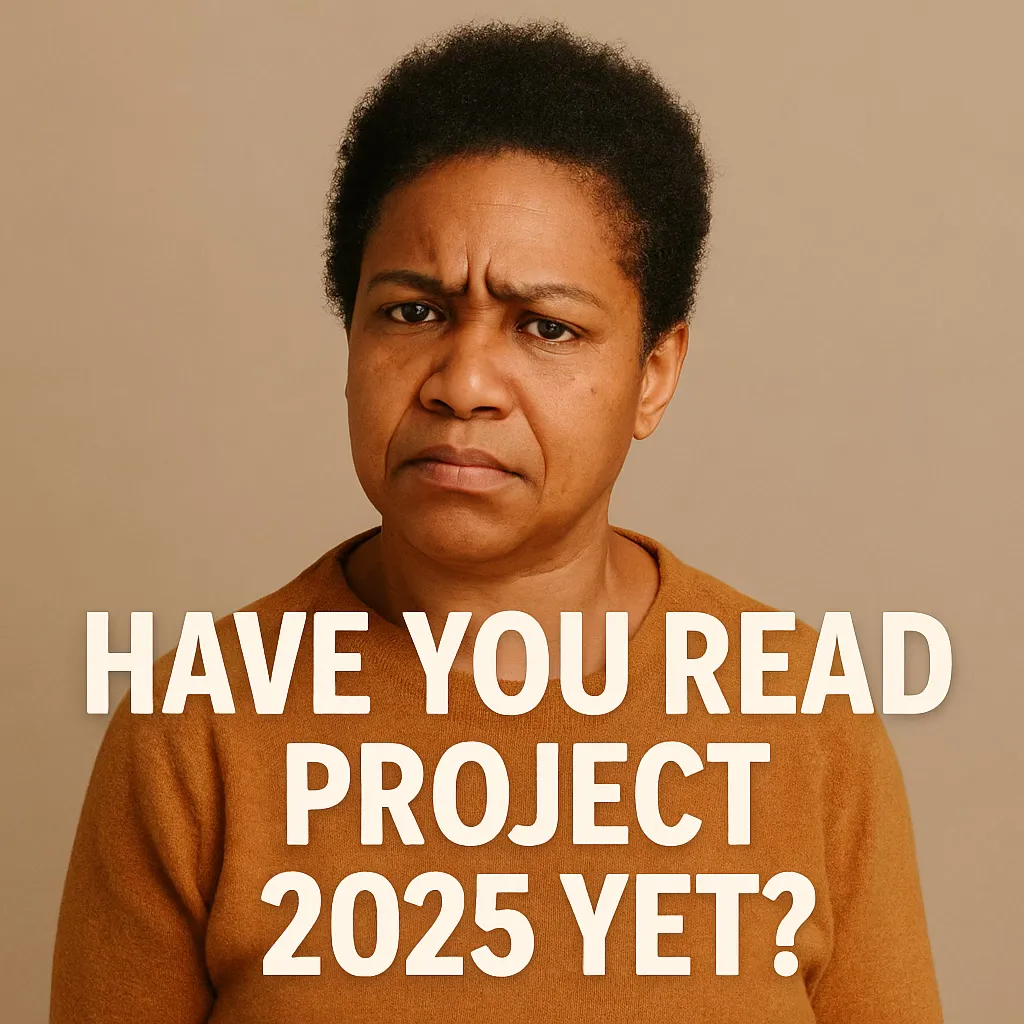
This simple statement is a compact vessel of collective frustration, lived wisdom, and moral clarity. When someone voices it today—whether about a president, a divisive governor, or a local official—they’re calling out: “We saw it coming, we could have prepared, but you decided otherwise—and now, this is the outcome.”
It’s a powerful mix of truth, warning, and restraint, reminding us that ignoring voices from the margins often leads to predictable damage. When Black women warned you, it wasn’t bitterness. It was biblical. We were saying…
Don’t confuse belief with blind obedience.
Don’t confuse prayer with silence.
Don’t confuse forgiveness with forgetting.
Real faith asks questions.
Real faith disrupts power.
Real faith listens to the voices that have survived oppression, not those who profit from it.
Call It What It Is…
This isn’t hindsight. It’s a historical pattern we keep trying to interrupt.
We warned you. We showed up. We still are…showing up.