I almost couldn’t believe what I was hearing.
“Yeah, she told me that they sorted the kids into two lines, by skin color. One line was for the oppressed, the other, for oppressors.”
This had allegedly happened in an elementary school in Topanga, California - a place I’d lived for almost two years.
I said “almost” because sadly, I could believe it.
Topanga is, as a friend says, a place for “hippies who have figured some things out.”
New Age spiritualists, nomads, holistic healers.
In the 60s it was a countercultural epicenter - the home of Marvin Gaye, Neil Young, and Jim Morrison.
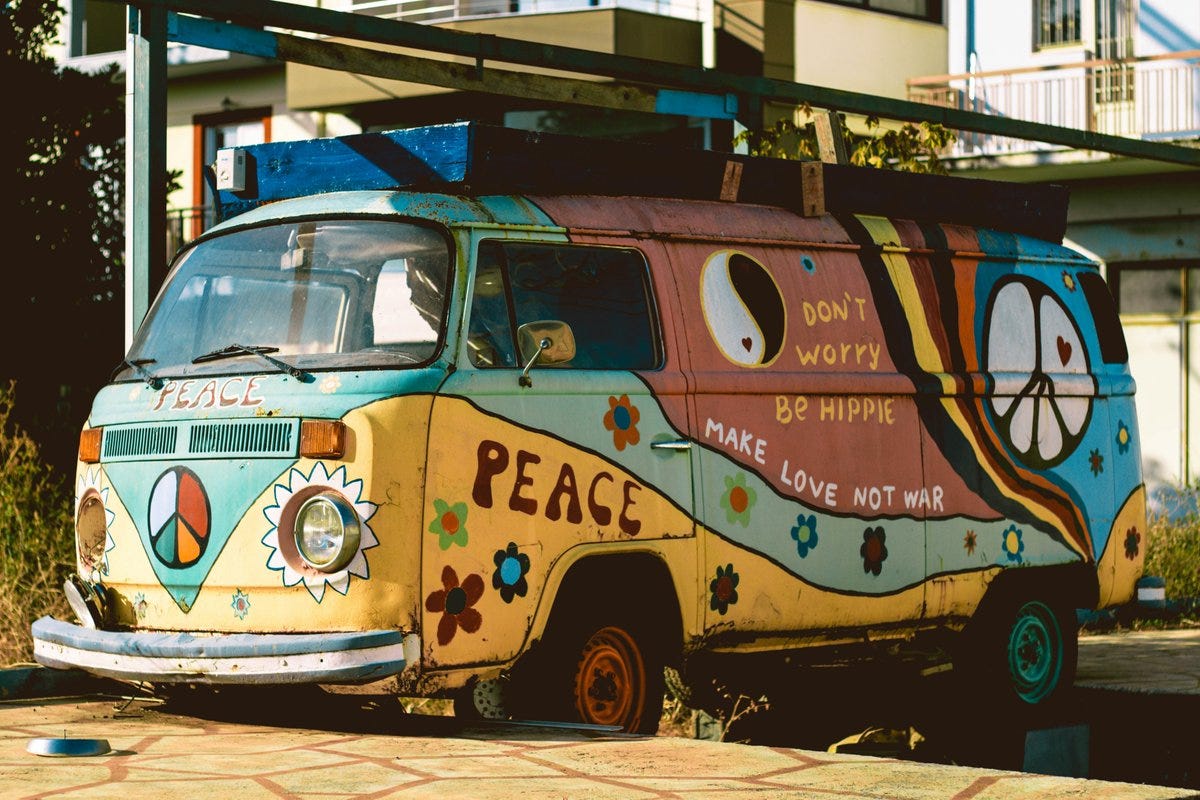 Photo by Vasilios Muselimis.
Hippie lifestyle, LA prices.
It’s also overwhelmingly white.
And being black - a rarity there - gave me a vantage point from which I could observe well-intentioned white peoples’ attitudes about race up-close.
So it was concerning, but conceivable, that this oppressor-oppressed exercise might be happening at a local elementary school.
Curious, I decided to investigate.
What I found was worse than I imagined.
This exercise wasn’t just happening in a quirky hippie town.
It was happening nationwide.
I. The Privilege Walk
The National Association of School Psychologists published “Talking About Race and Privilege: Lesson Plan for Middle and High School Students.”

It recommends the “privilege walk” - an exercise where students line up, close their eyes, and step forward or backward based on statements about their race and sex.
While intended to make students self-aware, this exercise teaches children to see themselves as members of races - rather than as individuals.
It installs the very race-consciousness it seeks to cure.
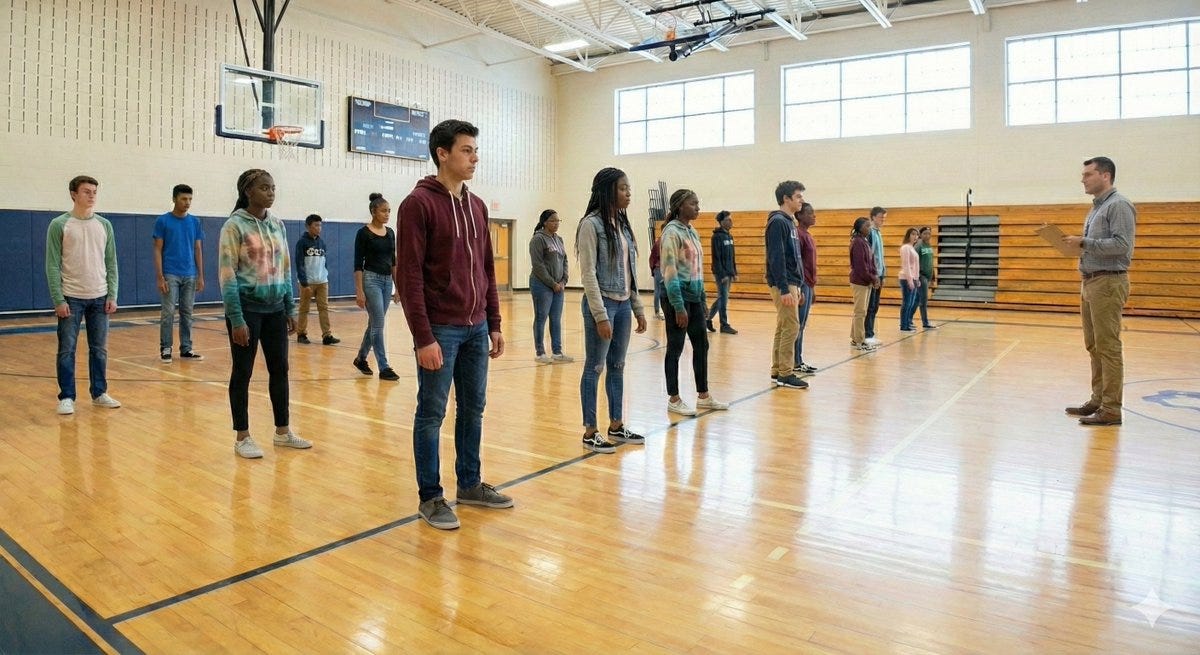 AI Illustration: A representation of the ‘Privilege Walk’ exercise.
The NASP represents over 25,000 school psychologists - and the privilege walk is widely used in schools across the country.
In 2021, at A.M. Kulp Elementary School in Pennsylvania, a fifth-grade teacher conducted a privilege walk.
According to multiple parents who spoke at school board meetings, students were lined up “from whitest to darkest” and white students asked to apologize to black students.
The school board confirmed that a privilege walk happened, but denied that an apology did.
There was disagreement on the specifics, but not that the exercise happened.
But even in the best case, the exercise itself is the problem.
As Samantha Ferry, who pulled her kids from the school, said: “Kids do not see color, and you are segregating them, and you are separating them.”
We’ve Become More Racial
I never did a privilege walk as a kid.
Growing up lower-middle class in the Bronx, I had friends across the spectrum: black, white, Asian, Hispanic.
 The Bronx, 1990s
I didn’t care what color they were.
I did discriminate - based on taste in video games, which version of Pokemon they played, and how stacked their Yu-Gi-Oh! deck was.
As far as I could tell, that was the norm.
We had fundamentally the same hardware - our biology - but connected over our shared software - our mindset.
As the son of immigrants from Ghana, my parents never spoke about race. They taught me to think of myself as an individual.
Someone with agency.
Someone who could achieve.
They raised me as an American, to pursue the American dream.
To focus on my future, not their past.
There were no privilege walks. No identification with oppression.
But something has changed since the 90s.
White people are being told they should feel guilty.
That “whiteness” is bad.
That they are the permanent villains of history.
Black people are being told that they should feel resentful.
That success comes from white supremacy.
That we are the permanent victims of history.
It’s swinging a pendulum of resentment between white and black.
Turning us against our history, against our civilization, against each other, and against ourselves.
And it’s based on an incomplete understanding of human history.
Specifically, the history of slavery.
This has left a wound open that refuses to close.
Healing requires truth. And the truth is more than we’ve been taught.
Everyone was a villain in the history of slavery. But the West was also the first hero.
Understanding this shifts the burden from a specific group, to humanity.
It also illuminates the truth: Good vs evil is not black vs white.
It is a war within the human heart.
It is only by telling the full history of humanity’s sins that we can be freed of the mental prison trapping people of all colors.
Free to see the West not as the antagonist of history, but as a complex protagonist - flawed, complicit, but the first to change.
Restoring the West’s moral confidence.
And reviving the Western spirit.
II. The West Is Demoralized.
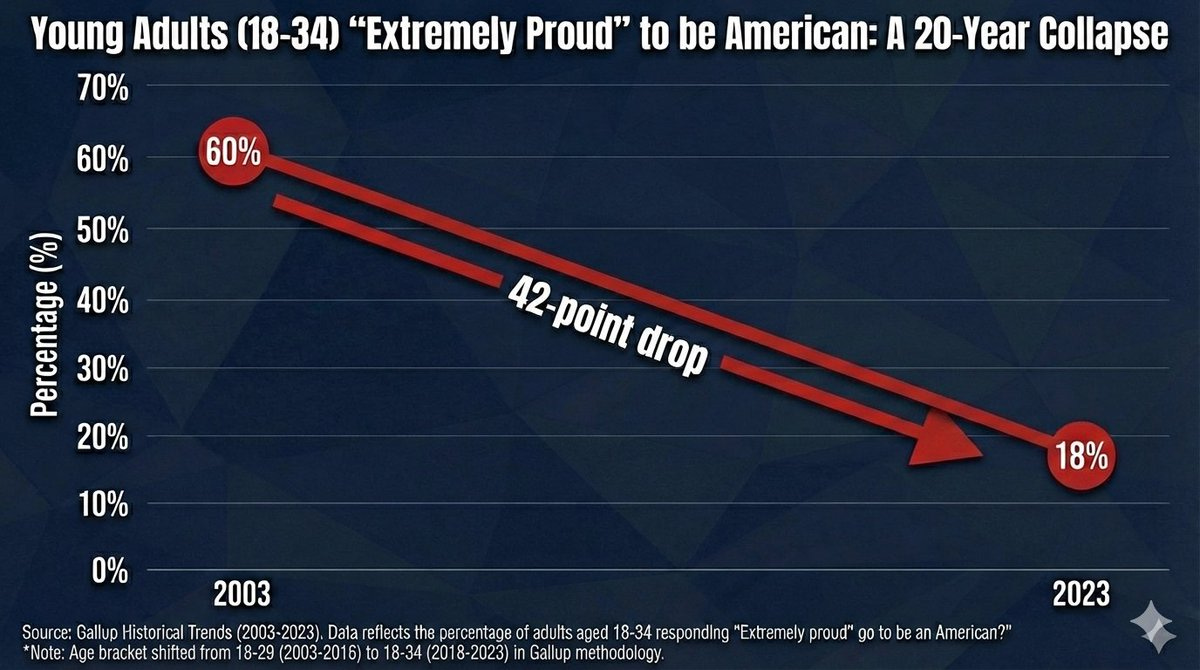
In 2003, 60% of young Americans were “extremely proud” of their country.
Today, that number is just 18%.
 All sources and citations linked at end of article.
A 42-point drop.
And for many, pride has been replaced by shame: a 2025 Harvard poll found that nearly one-third of young Americans are explicitly “embarrassed” to be American.
Across the Atlantic, the collapse is even more stark.
Among young Britons (age 18-24), only 24% are proud of the British Empire, while 35% are explicitly “ashamed” of it.
The nation that abolished the global slave trade, wallowing in shame.
Western universities have become infected with illiberal attitudes: 1 in 3 American college students now think it’s acceptable to use physical violence to stop speakers from speaking on campus.
An attitude fundamentally incompatible with a cornerstone Western value - free speech.
Race relations have similarly suffered.
In 2001, roughly 70% of Americans rated black-white race relations positively.
Today, that’s fallen to 53%.
But more telling: 59% of black Americans now believe race relations will always be a problem.
We spent the last decade talking about race more, yet the fruit of that fixation is less hope.
The Moral Accounting
A nation consumed by self-hate cannot be great.
Self-loathing has corroded both the American psyche and the soul of the West.
How did this happen?
Through the stories we tell about ourselves.
And the most powerful story is history.
We’ve taught America’s youth that slavery is America’s original sin - not humanity’s.
This has led to a partial moral accounting: a ledger where Western sins are emphasized, but wins are explained away.
The American education system is the point of failure.
As this UCLA student explains - he was taught one version of history in school. He learned the rest online.
Undergrad explains how he learned the true history of slavery | Music: “Clean Soul” by Kevin MacLeod (incompetech.com). Licensed under CC BY 4.0.
America’s future leaders are getting a partial education.
TikTok is filling in the gaps.
The Miseducation of America
Maybe you know that slavery long predates America.
That it was practiced globally.
That the West ended it first, and pressured non-Westerners morally and militarily to follow suit.
But many young people don’t.
I verified this for myself by asking college students at UCLA - one of the top public universities - about the origins of slavery.
I Asked UCLA Students About Slavery | Music: “Grand Dark Waltz Moderato” by Kevin MacLeod (incompetech.com). CC BY 4.0.
They all knew slavery is evil.
Some of them thought it started in America.
Many of them didn’t know Africans sold Africans to Europeans.
Few of them knew how it ended globally.
Keep in mind - these are elite students.
They didn’t know because they weren’t taught.
Why?
- Why do American children learn about the horrors of the Trans-Atlantic slave trade - but not the African slavers who supplied it?
- Why do they learn about Jefferson’s slaves - but not the 150,000 Africans freed by the British Navy?
- Why is stating the fact that the British were the first major power to end slavery met with condemnation, not celebration?
Konstantin Kisin tells the truth about the British Empire leading the first global abolition movement.
Selective history creates moral hierarchies.
Teach children that white people invented slavery, and you teach them who to blame.
Teach them that the West was the first to end it globally, and the narrative collapses.
But challenge the narrative, and you threaten those who profit from division.
The selective anti-Western critique is not dismantling hierarchy.
It’s inverting it.
Trading the old lie - that black people are biologically inferior - for a new one: that white people are morally inferior.
Is the new hierarchy as brutal as the old? No.
But it is just as false.
And you cannot build unity on a lie.
Because hierarchies prevent healing.
A Monopoly On History
Often when someone acknowledges global slavery, they’re accused of minimizing the Trans-Atlantic Slave Trade.
But consider: every American student learns about the Middle Passage. The horrors of plantation life. The brutality of chattel slavery.
As they should.
But when college students at one of America’s top universities don’t know slavery existed before America - when they think one of humanity’s oldest evils was invented here - there is a gap.
TikTok shouldn’t be filling in the gaps.
We should.
The Trans-Atlantic Slave Trade hasn’t been minimized.
It’s been maximized to the point of monopoly.
I’m not saying we should talk about it less.
In fact, we should talk about it more than other slave trades - because, of course, it happened here.
I’m saying we should also talk about the rest of the world.
One essay acknowledging thousands of years of global slavery won’t minimize Western slavery.
It’s a step toward balance.
Destructive vs Constructive Criticism
In 2021, the Thomas Jefferson statue was removed from New York City Hall after 187 years - because he owned slaves.
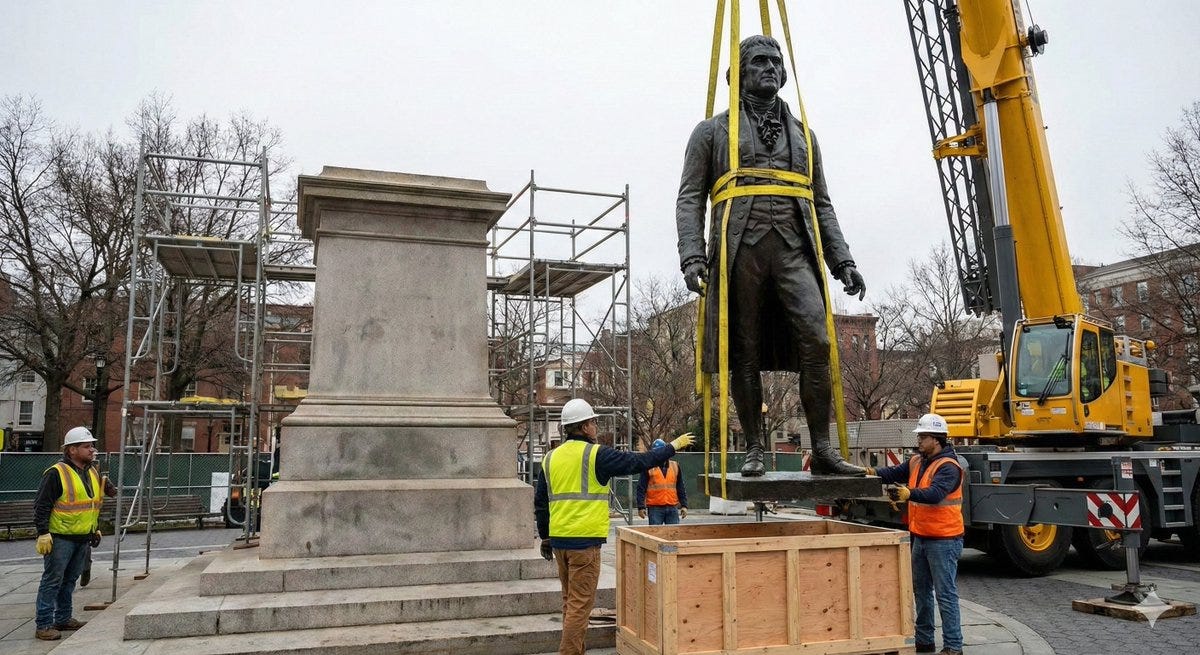 AI Illustration: Removal of Jefferson statue
That same year, the San Francisco Board of Education voted to rename 44 schools, including Abraham Lincoln High School, George Washington High School, and Jefferson Elementary.
Parents revolted strongly enough that the board rescinded the decision.
But the impulse was there.
To destroy monuments of history.
The heroes of history, recast as villains.
But consider how the black architects of freedom - the giants whose movements secured the 13th Amendment and the Civil Rights Act - spoke of the Founding Fathers.
- Frederick Douglass: escaped slavery, studied the Constitution, and came to call it a “glorious liberty document.”
- Martin Luther King Jr.: beaten, jailed, and murdered. Called the Constitution “magnificent words,” a promissory note America needed to honor.
- Today’s selective activists: Beneficiaries of the very rights King died for. Call the Constitution “trash” written by “slavers and colonists.” Claim the founding ideals were “false when they were written”.
Those who suffered most stayed constructive. Those who suffer least have become destructive.
Douglass and King didn’t seek to tear the Constitution up. They sought to enforce it.
They were constructive - demanding America live up to its own ideals.
The selective critic is destructive - demanding we condemn the foundation entirely.
One wants to build on the Western foundation. The other wants to tear it down.
And that destructive impulse is based on a partial telling of history, which goes like this:
Slavery was an American institution. Created by white people to subjugate black people. It started and ended in America. White people were the oppressors and modern whites are collectively guilty. Black people were oppressed by whites, and have a grievance that must be satisfied by modern whites, but never will be.
There’s just one problem.
It’s incomplete.
III. The True History Of Slavery
Slavery is evil.
And it’s an ancient human evil - done by everyone, to everyone.
Evidence of slavery dates back thousands of years. Some evidence suggests at least 11,000 years. It predates written language, and likely, civilization itself.
It was normal.
Not because people thought it was right.
As economist Thomas Sowell observes:
“It was not because people thought slavery was right that it persisted for thousands of years. It persisted largely because people did not think about the rightness or wrongness of it at all.“
What varied was not whether people enslaved people - but how.
Sins Of Our Fathers
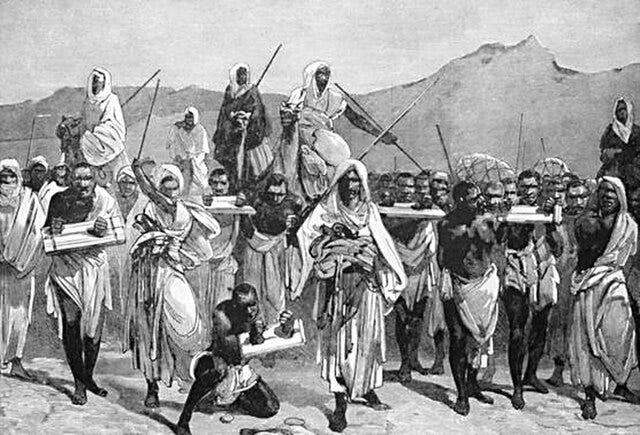 Trans-Saharan Slave Trade Depiction from a 19th-century engraving | likely from illustration by John Frederick Lewis (d. 1876)...
The Trans-Saharan Slave Trade: Long before Europeans began the Trans-Atlantic Slave Trade, millions of Africans were marched across the Sahara to be sold in the Middle East.
Mortality estimates for that journey range from 20-50%.
Men and boys were routinely castrated.
Boys as young as eight, with no anesthesia, using crude knives and hot irons.
Most did not survive.
Mortality rates ranged from two-thirds to as high as ninety percent.
That’s why the African-descended population in the Middle East is small relative to America’s, despite the Arab trade lasting longer and taking more slaves.
The Barbary Slave Trade: For over three centuries, North African raiders captured and enslaved over a million Europeans.
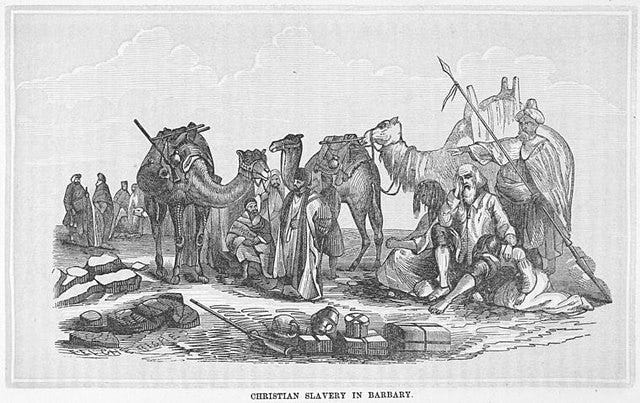 Enslavement of Christians in the Barbary Slave Trade | Author - Blake, William O....
Those slaves were kept on ships, where they were chained to oars, whipped, and left to row until they collapsed.
The African Supply Chain: Historians estimate around 90% of Africans sold to European traders were already enslaved - by other Africans.
Coastal kingdoms built their economies on capturing and selling their neighbors.
European traders didn’t hunt most slaves - that would have been difficult because they struggled to survive diseases like malaria and the harsh conditions of Africa.
So they bought them.
The Chinese, Koreans, Japanese, Indians, Native Americans, Aztecs - even Buddhist monasteries owned slaves.
What made the European version unique was not its immorality - but its scale.
Advanced naval technology let them enslave across oceans.
Slavery was common in Africa prior to Europeans. They didn’t invent the supply chain.
They plugged into the existing one.
The Chattel Slavery Argument
Some will say: “But American slavery was different. It was chattel slavery - hereditary, race-based, uniquely dehumanizing.”
American chattel slavery was evil.
Children born into bondage, their humanity denied by law.
Monstrous.
And similar monstrosities existed elsewhere.
The Arab slave trade was also hereditary.
Children of slaves were legally slaves.
But they also castrated boys.
One system said: your descendants will be slaves.
The other said: you will have no descendants.
One left a scar.
The other left a void.
Arguing which is “worse” misses the point entirely.
Evil is not a competition.
The medal for malice belongs to mankind.
Recognizing its universality releases us all from racial blame games.
It also enables us to see clearly which culture’s software broke everyone out of that evil.
No civilization has clean hands - and the West washed its hands first.
Before “White” and “Black”
There were no “white people” and “black people” when slavery began.
The English fought the Spanish. The Ashanti fought neighboring tribes.
When African kingdoms sold captives to European traders, they weren’t “selling out their race.”
They were selling their enemies - as they had throughout history.
The concept of “white” and “black” as unified racial categories was invented in the late 18th century - by European scientists who decided to categorize humans into a hierarchy.
That hierarchy was then used to justify slavery retroactively.
Just as all forms of prejudice are used to excuse evil.
But slavery didn’t need racism to exist.
It predated the concept of race by thousands of years.
Racism was a rationalization after the fact. Not the cause.
The Effects Of Racism
Now, to be clear:
The Trans-Atlantic Slave Trade operated on an industrial scale - over 12 million Africans shipped across the ocean.
And the aftermath of American slavery was unique in its racial coding.
- Jim Crow.
- Segregation.
- Redlining.
A century of legal oppression whose effects still echo today.
That legacy is real. It should not be dismissed.
And - the institution of slavery itself was global.
As Sowell writes:
“From a narrow perspective, the lesson that some draw from the history of slavery, automatically conceived of as the enslavement of blacks by whites, is that white people were or are uniquely evil.”
“Against the broader background of world history, however, a very different lesson might be that no people of any color can be trusted with unbridled power over any other people.“
I Was In A Slave Dungeon
Five years ago I went to Ghana.
I stood in a slave dungeon.
In a castle, where people who looked like me, sold other people who looked like me…to white people.
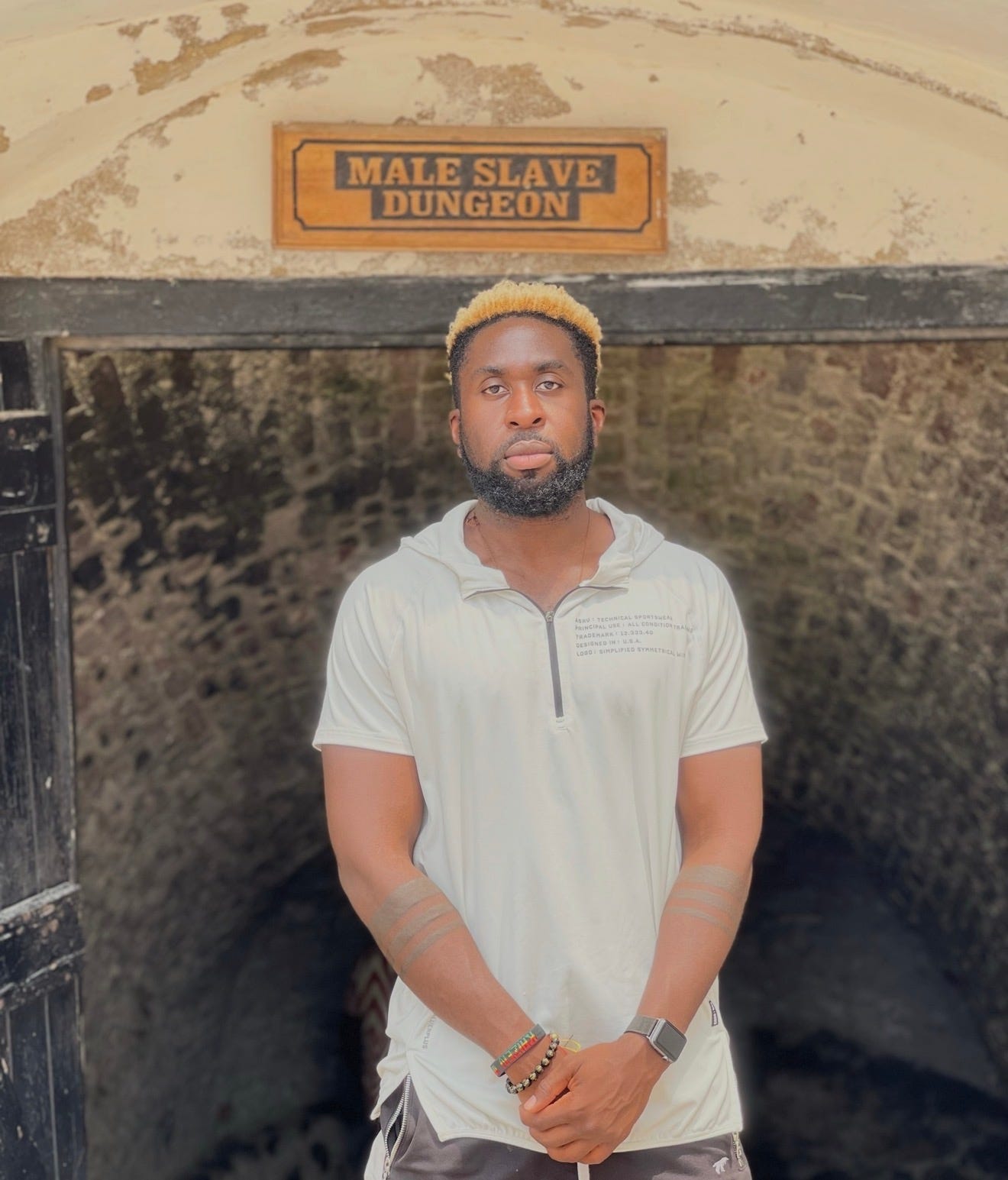 Me at Cape Coast Castle, 2021
I saw the chains they wore.
Touched the walls they touched.
Stood in the despairing darkness with the dungeon’s door closed.
The air was heavy with the weight of history.
The silence, absolute.
And then I realized something I’d never thought about.
Slavery was universal.
Because evil has no color.
We should never minimize evil.
But we must recognize it as human - so we stop associating it with a particular group.
Everyone participated in slavery.
The question is: who decided to stop it?
IV. The West
Every civilization was a villain in the history of slavery. Western civilization was the first hero.
There were slave revolts - Spartacus in 73 BC, Haiti in 1804. They fought courageously for their own freedom.
And the West did something unprecedented: it turned against slavery from the position of power, and waged a global campaign to end it everywhere.
The West didn’t invent slavery.
But it did invent the critique of slavery.
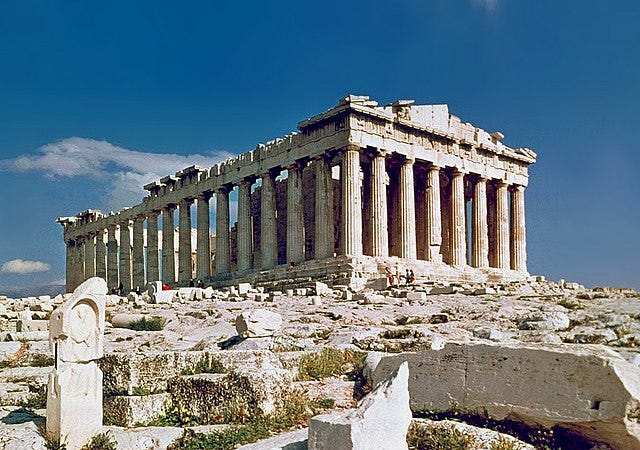 Parthenon, Athens Greece. 1978. | Author - Steve Swayne
The same intellectual tradition that moved the Earth from the center of the universe, that separated church from state, that enshrined individual rights - that tradition turned its gaze on an ancient institution and answered: This is wrong.
No other civilization had turned against the institution, while they held the whip.
The British were the first to fight it globally.
In 1807, Britain abolished the slave trade.
In 1833, they abolished slavery itself throughout the Empire - which at the time comprised one quarter of the planet.
And this wasn’t the politics of the elites. It was a grassroots moral revolution.
Women who couldn’t vote boycotted slave-produced sugar.
Sugar bowls were inscribed: “Not Made By Slaves.”
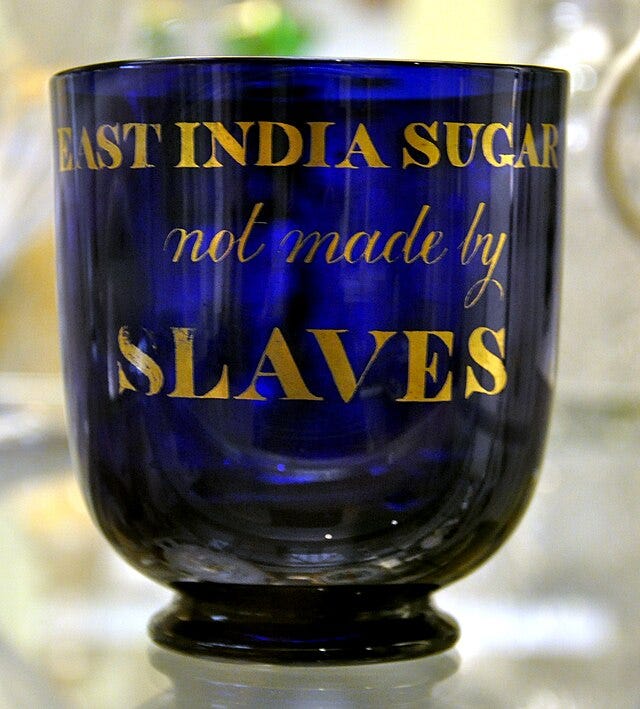 “Not Made By Slaves” glass sugar bowl est. 1820-1830 | Credit The British Museum
The birth of ethical consumption.
Then Britain did something unprecedented.
They didn’t just stop slavery in their empire. They used their power to stop other empires.
They pressured the Ottoman Empire to close its slave markets.
They sent warships into Brazilian waters, firing on coastal forts until Brazil agreed to end the slave trade.
The Royal Navy’s West Africa Squadron intercepted slave ships for over 50 years - freeing an estimated 150,000 Africans.
Some argue this was all just economics. That abolition was about money, not morality.
This argument falls apart upon basic scrutiny.
- If ending slavery was profitable, why did Britain spend 40% of its national budget to compensate slave owners? That loan wasn’t fully paid off until 2015. British taxpayers were paying for abolition for 182 years.
- Why did almost 1,600 British sailors die intercepting slave ships, mostly from disease?
- Why pressure trading partners to abandon a system that gave Britain a competitive advantage?
- In America, the Civil War killed upwards of 750,000 people - more than every other American war combined, and Reconstruction cost billions.
The idea that abolition was a money-saving measure is historically inaccurate.
It was based on moral grounds. Grounds that didn’t even exist in other civilizations.
In 1841, a British consul reported this exchange with the ruler of Zanzibar:
The ruler said Arabs were not “like the English who were always reading and writing” and were unable to understand the anti-slavery viewpoint. The British obsession with it was “quite inexplicable” to them.
Inexplicable. Because the moral vocabulary did not exist outside the West.
In fact, slavery still exists in some of those places. But not in the West.
A Simple Logic Check
- If we judge civilizations by their participation in slavery, every civilization must be condemned.
- If we judge them by who ended it first, the West must be celebrated.
You can’t apply the first standard without applying the second.
The destructive critic wants to count the sins but not the wins.
They condemn the slave-holder, but won’t credit the abolitionist - when they were often the same civilization, sometimes the same person, wrestling with an institution older than recorded history.
V. The Founding Fathers
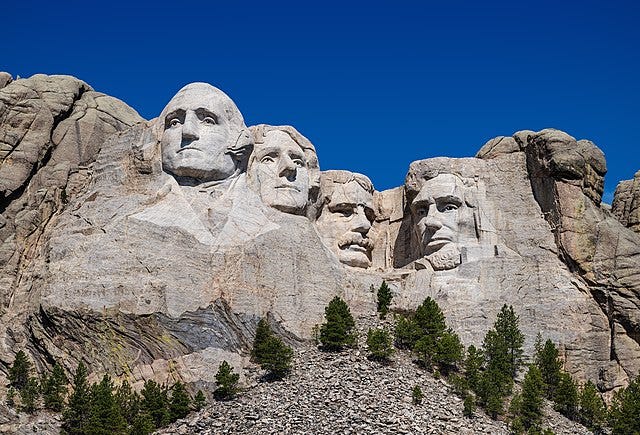 Mount Rushmore | Thomas Wolf
When people say “The Founding Fathers were slave owners,” they’re flattening history.
Yes, many were.
But this fact is used to dismiss their achievements - as if it proves they were frauds.
It was used to take down Jefferson and Washington’s names in San Francisco and New York.
The full picture is more human.
They didn’t create the system. They were born into it.
Washington and Jefferson inherited slaves as children in Virginia.
And for much of their lives, they participated fully in that system - buying, selling, and profiting from human beings as the “business” it was viewed as at the time.
That was wrong.
Principles are timeless, even if people in the past didn’t see them.
But here’s what distinguished them from their predecessors.
They tried to dismantle the system they participated in.
Jefferson
As a young lawyer, Jefferson represented slaves for free in freedom suits.
He tried to condemn slavery in the Declaration of Independence. Congress removed it.
He authored Virginia’s law banning slave imports.
As President, he pushed Congress to end the slave trade entirely.
And yet - he was not a hero on slavery. He was complicit.
He freed almost none of his slaves.
He profited from their labor.
He was also trapped by debt.
Under Virginia law, slaves were collateral. He couldn’t free them without paying off creditors.
He died with the modern equivalent of millions in debt.
Jefferson planted ideas that outlived his contradictions. But he never escaped them.
Washington
Washington had more options - but Mount Vernon, the estate he inherited, ran on slave labor.
Freeing them during his lifetime would mean financial ruin.
He, like Jefferson, was land-rich and cash-poor.
So he waited.
He benefited from their labor his entire life.
He pursued those who tried to escape.
And then, in his will, he freed all 123 of his slaves - and funded their care and education.
Was it heroic? No.
He freed them when it cost him nothing.
But it was rare. While others passed their slaves down to their heirs, Washington ended the cycle - and paid for their future.
Neither man was pure. Neither fully escaped the system they were born into.
But the words they fought for - “all men are created equal” - became the weapon Lincoln used to end slavery for good.
“There, but for the grace of God, go I.”
We are not better than the Founders were. We are luckier.
Imagine 100 years from now that clean energy is cheap and abundant.
Humanity looks back at us with horror.
“They knew carbon was destroying the planet. They knew - and they kept burning it.”
Now imagine them saying:
“The climate activists of 2026 were hypocrites. They drove cars. They flew on planes. They participated in the system.”
Would that be fair?
Or would we want them to say:
“They saw what was wrong, and tried to move society toward the good, within the constraints of their time. They couldn’t opt out entirely. But they pushed.”
That’s the Founders.
“All men are created equal” is an ideal. They didn’t embody it perfectly.
But it was the first time in history anyone had even tried.
Philosophers had mused about equality. Religions had preached it.
But no nation had ever been founded on it.
If we demand flawless heroes, we’ll have none.
Greatness is not the absence of flaws. It is the transcendence of them.
We don’t celebrate the Founders because they met the standards of our time.
We celebrate them because they surpassed the standards of theirs.
And tearing down their statues doesn’t erase their flaws.
It erases the symbols of the ideals they gave us to judge them by.
VI. Black Grievances, White Guilt
Selective history doesn’t just distort the past. It condemns the present.
When you teach that “whiteness” is the source of oppression, being white becomes a moral defect.
Something children apologize for in classrooms.
That’s how you get peer-reviewed academic journals publishing papers describing whiteness not as a skin color, but as a “malignant, parasitic-like condition.”
An article in the Journal of the American Psychoanalytic Association claimed whiteness has “voracious, insatiable” appetites and renders its hosts “susceptible to the contagion.”
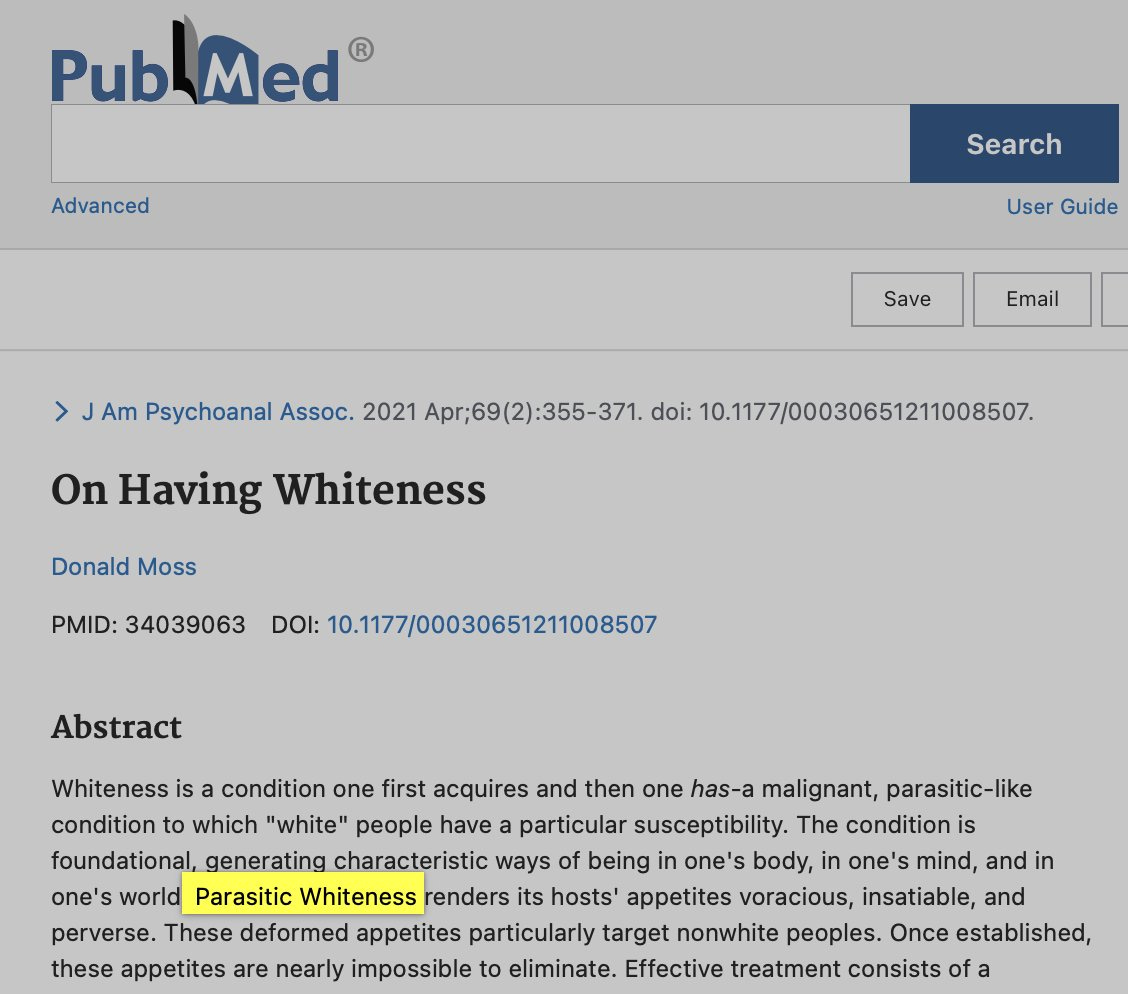
This passed a peer-review.
They are pathologizing a race.
Treating a skin color like a disease.
But the only disease here is the dehumanization itself.
Humans have dehumanized each other over tribe, religion, and caste since the dawn of time.
We speak about white people as if they’re uniquely capable of evil.
But in our capacity for good and evil, we are all equals.
The Trap
And it’s not just white people who are harmed by this framing.
In 2020, the Smithsonian’s National Museum of African American History posted an infographic listing “aspects of whiteness.”
Among them: hard work, self-reliance, punctuality, delayed gratification, and the nuclear family.
Universal virtues - the same virtues that built every successful civilization, including many African and Asian ones - labeled as “whiteness”.
The nuclear family - associated with whiteness - when before the 1960s, blacks had higher marriage rates than whites.
The implication? These virtues are inaccessible to black people. That would be “acting white”.
If whiteness is a moral defect, then success from whiteness must be ill-gotten.
Achievement becomes evidence of oppression. Competence becomes complicity.
This is how you trap people.
You tell them success is supremacy.
You tell them the tools of achievement belong to their oppressors.
And then you wonder why they don’t achieve.
The backlash was swift enough that they removed the Smithsonian exhibit.
But the impulse was there - and the worldview behind it remains.
Seeing The World In Color
I saw this firsthand.
A friend of mine was fired. His employer wanted him there 15 minutes before his shift, unpaid.
He wasn’t doing that.
And he’d been coming in smelling like weed.
Customers complained.
He was let go.
When he told me about it, he mentioned colonialism. Mentioned that white people burn Palo Santo, but the scent of marijuana is demonized.
I heard him out. Then I told him the truth.
“Bro, it sucks to be let go. But most people just think weed smells bad. I’ve smoked plenty in my life, and I think it smells bad too.”
(There’s a reason no one’s making weed cologne.)
“If you go to your employer talking about colonialism, you’re not going to connect with him. How about a direct conversation? ‘Hey, if you want me here 15 minutes early, I need to be compensated.’ Timing. Compensation. Concrete stuff.”
There was a pause.
Then I heard scribbling.
“Wait… are you writing this down?” I asked.
“Yeah, I didn’t get this far by not learning,” he said.
That’s why I love him. Because he wants to win. And these beliefs were getting in his way.
When you view the world through the lens of color, you can’t see clearly.
You become blind to your behavior, and bound to factors outside your control.
It puts you in a mental prison - one only you can unlock.
Tribalism
Black-and-white thinking is making us tribal.
Earlier this year, a young man named Karmelo Anthony stabbed and killed Austin Metcalf - a teenager. The facts were clear. Karmelo confessed.
And yet, hundreds of thousands of dollars in donations poured in for Karmelo’s legal defense, from black and white people.

As if his skin color made the immorality of the murder ambiguous.
A few weeks later, a woman named Shiloh Hendrix called a child the n-word in a park.
Obviously not as bad as murder.
But still hateful. Indefensible.
And yet, donations poured in for her too - mostly from white people, in response to Karmelo’s support.
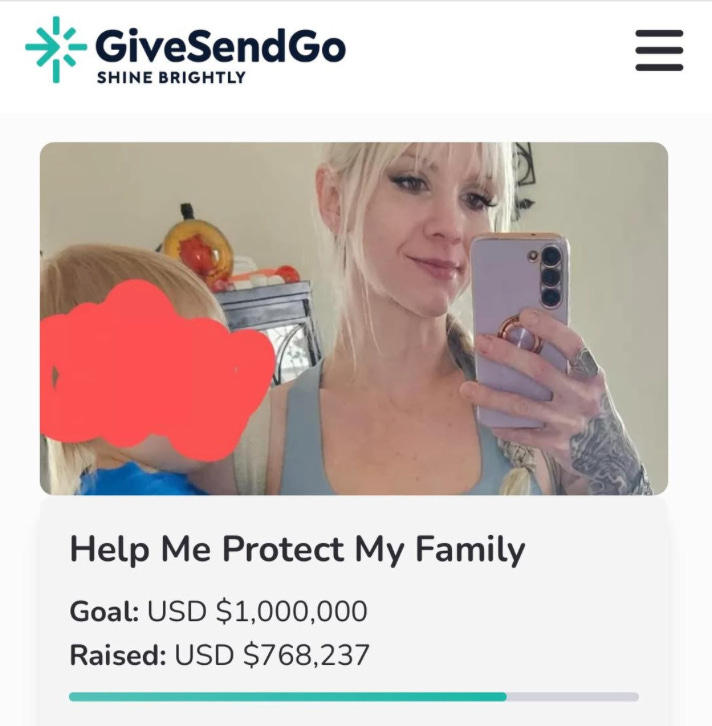
Both sides, rushing to defend their tribe, or to be seen as an ally.
Both sides, more interested in melanin than morality.
This is what happens when you sort people into groups instead of judging them as individuals.
It causes people to abandon principles for preferences.
Collective Guilt
If we’re going to attribute collective guilt across time, then we need to do it consistently.
If white people today inherit guilt for slavery, then they also inherit credit for abolition.
If we’re condemning the descendants of slaveholders, we should also condemn the descendants of the African kings who sold their neighbors.
But I don’t believe in collective guilt across generations.
The people who exist today are not the people who existed then.
We don’t inherit the sins of our ancestors - and we don’t inherit their virtues either.
We are individuals.
Judged by what we do.
Not by what people who shared our skin color did centuries ago.
Wake Up, West
If everyone around you is doing the wrong thing, and you’ve been doing it too, but you’re the first to wake up and stop - should you only be condemned like everyone else?
Or should you be recognized as the one who woke up first?
That’s the West.
The West didn’t invent slavery.
But we were the first to end it.
That’s what we should be teaching America’s youth.
Complete history.
Aware of our sins, but focused on our wins.
The Enlightenment values - individual dignity, rule of law, the belief that all men are created equal - were birthed in the West.
But they don’t belong to white people.
They belong to everyone.
The battle between good and evil is real. But it’s not between races.
It’s within the human heart.
In our capacity for good and evil, we are all equals.
Morality is not a matter of melanin.
The full story sets us free. Share it on X.
Sources & Citations here.