Nine activists have committed themselves to blockading construction by TransCanada of the Keystone XL pipeline project through Texas to the Gulf of Mexico. The activists have established a position in trees that TransCanada must cut down in order to build the pipeline. They have decided to engage in nonviolent direct action to stop TransCanada from destroying land for the tar sands pipeline.
The resistance is getting under the skin of TransCanada. Just yesterday, as Jane Hamsher detailed, TransCanadaencouraged law enforcement to use torture tactics on blockaders. Now, three days into the blockade, TransCanada’s machinery for cutting down trees is twenty feet away from blockaders, a violation of federal safety regulations. The corporation is refusing to turn off their machinery and leave.
I spoke with Ron Seifert, a spokesperson for the Tar Sands Blockade. He recounted what happened to blockaders yesterday and then explained why activists find it critical to be out resisting construction of the tar sands pipeline.
*
KEVIN GOSZTOLA, The Dissenter: To start off, how long has the Tar Sands Blockade been engaging in action?
RON SEIFERT, spokesperson for the Tar Sands Blockade: The Tar Sands Blockade campaign launched in mid-August, however, the sustained tree blockade is now in its third day.
GOSZTOLA: How is the blockade being mounted? How are you blockading the Keystone XL pipeline project?
SEIFERT: There’s two different tactics being employed. There is a tree village. There are platforms and a full tree house, two-story tree condo, if you will, that are all connected via zip lines and traverses throughout an old oak forest. Altogether, there are over a dozen trees that span the entire pathway of the Keystone pipeline. Additionally, there is a scaffolding—a structural wall made of timber—and built along the top of that wall is a catwalk, an additional platform supporting blockaders as well. Between the timber wall and the tree blockade, there are nine different blockaders all dedicated to maintaining their positions and holding out as long as it takes to stop the Keystone XL pipeline once and for all.
GOSZTOLA: These structures were put in before construction was to begin?
SEIFERT: That is correct. Unfortunately, the massive project is ongoing at multiple locations, every day simultaneously. As much as the blockade wants to stop and protect every piece of land that is being destroyed and permanently scarred by construction as we speak, we understand that we have to hold basically one place and really dig in and this is a great opportunity to draw a line in the sand and let the world know that we are rising up to defend home. We are going to fight for a future with out the tar sands pipeline.
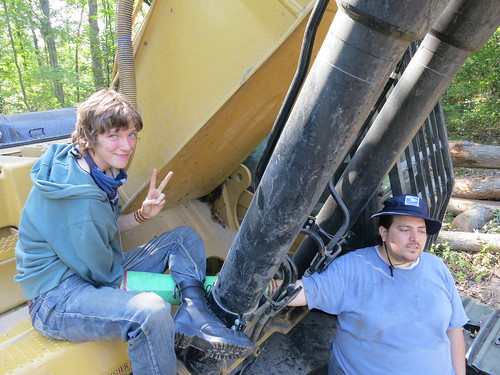
Shannon and Benjamin | Photo by Tar Sands Blockade
GOSZTOLA: I understand that some of the members, who have participated in the blockade, have been arrested. What can you say about the arrests?
SEIFERT: To date, there have been fourteen blockaders arrested at various construction sites for shutting down construction and protecting Texas land and Texas homes from construction. Yesterday was the most abusive confrontation with TransCanada and law enforcement. TransCanada supervisors encouraged law enforcement to use escalated pain compliance techniques on our blockaders. They stood by and watched while blockaders were effectively tortured. They were handcuffed into stress positions. While they were pepper sprayed and tasered, they were put into chokeholds. They were physically abused all while TransCanada supervisors watched and, when blockaders were removed from the scene and arrested, TransCanada supervisors thanked law enforcement and commended them on a job well done.
GOSZTOLA: So this is an escalation? In the days before, you didn’t see this sort of conduct?
SEIFERT: No, for the most part all of our interactions with law enforcement have been relatively civil. There was one encounter where a blockader was contorted into an uncomfortable position, but this is the first time that non-lethal weapons were used on blockaders and it is also the first time that they were handcuffed and physically restrained. Basically, law enforcement handcuffed blockaders to the equipment so they could not move, immobilized them, and then proceeded to use non-lethal weapons on them.
GOSZTOLA: Were the people arrested released? Were any of them injured by the use of weapons or torture tactics? Did they return to take positions in the blockade again?
SEIFERT: They do have bruises and emotional scarring from the incident. Of course, they were in overwhelming pain for periods of time for doing nothing more than peacefully protesting. There was absolutely nothing violent or not even one word uttered by the blockaders. It came from reports on site that it was at TransCanada’s discretion that these pain-inducing tactics were utilized.
As far as the blockader’ health, they are surprisingly in good spirits. They want to encourage folks across the country to not let these brutal tactics stand behind them and their conviction, that the only way we can stop this pipeline is to collectively rise up and show this multinational corporation that their brutality will not deter our resistance.
They are out of jail. They were released last night on bond. They were $2000 bails. They are with friends and family right now recovering.
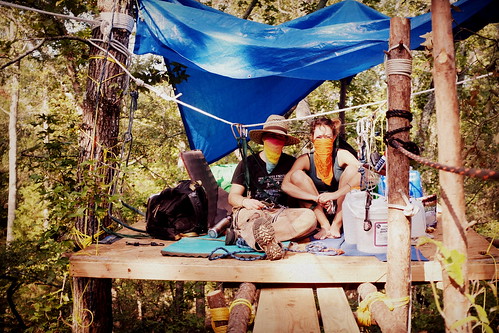
Our Forest Defenders | Photo by Tar Sands Blockade
GOSZTOLA: Finally, what is at stake here? What does it mean that a multinational corporation, TransCanada, is recruiting law enforcement to suppress people who are resisting their construction?
SEIFERT: Maybe we shouldn’t be surprised that TransCanada is recruiting the state to do its dirty work because they’ve already co-opted the state power of eminent domain, which is an extraordinary ability for a third party to seize unilaterally private property which is intended for a public good or a public use. In the case of the Keystone XL pipeline, this multinational corporation has been granted the ability to seize private property for their own private good, private gain. So, it’s an egregious overreach that is resulting in the transference of thousands of acres of private property in Texas to this multinational corporation so they can further enrich themselves.
To do this, this is all predicated on tar sands exploitation. Tar sands exploitation in Alberta [in Canada] is the most ecologically devastating project right now on planet Earth. And I know that sounds a bit hyperbolic but it truly is the case. Industry has earmarked over 53,000 square miles of boreal forest for clear-cut and strip-mining, forest area the size of New York state that will be permanently destroyed and permanently lifeless.
The amount of carbon that exists in the tar sands formation is enough to put Earth over the edge. Our global climate would never recover if every drop of tar sands is allowed to be mined, processed and burned. We simply don’t have the carbon budget for it, and, accordingly stopping the Keystone XL pipeline, which will open the floodgates to this type of exploitation, is a necessary condition for protecting a viable future on this planet. If we do not do this, it really is game over for future generations. This is something that must be stopped. It’s dangerous. It affects us all. And for those directly impacted that are in the lines of the pipeline itself, these are folks whose water and land are threatened and folks in most cases wanted nothing to do with this pipeline and were forced into harm’s way by TransCanada.
There’s a whole host of reasons why we oppose this pipeline. It’s too dangerous to exist andTarSandsBlockade.org offers the capacity anyone and everyone that wants to participate in stopping this thing to sign up and get plugged in. There’s room for all different levels of participation and we need help. Right now is the time. This is our moment and we’d love to hear from everyone out there.
Firedoglake (and Films For ActioN) is supporting the fight of the tar sands blockaders. Donate to send supplies to the blockaders here.
KEEP OUR LIBRARY FREE
$5/month keep us freely available to all. No paywalls for 99% of content, no ads, just people-powered media.
Subscribe here.