Over many years as an activist, attorney and artist working on environmental campaigns, Chris Desser began to wonder about the sensual pleasures that will disappear from our lives as more and more species go extinct. That was the genesis of her “Catalog of Extinct Experience”— a multimedia installation at San Francisco’s Fort Mason Center planned for the Fall of 2013.
“At its most basic, as we lose these experiences we lose ways of coming to consciousness,” Desser explains. “These things are all part of the commons— these experiences belong to all of us.
Some of the exhibits that she is planning for the exhibition include:
—Images of endangered landscapes preserved in jars, like extinct species preserved in formaldehyde;
—Recordings of soundscapes from rainforests, deserts and other threatened places;
—Vials of perfumes made from endangered plants;
—Honey flavored by various flowers, with empty jars for extinct species;
—Commissioned and curated work from other artists.
Desser stresses it’s not inevitable that we will lose many of the experiences that bring delight and meaning to our everyday world. Indeed, she ‘s creating the Catalog of Extinct Experiences to rouse people to protect this little recognized but crucial element of the commons. “It’s a subtle thing that many people don’t realize is happening. I want to raise people’s awarenss of it.”
That’s why she’s asking people to contact her at [email protected] with their own thoughts on endangered or extinct experiences. For more information see the Catalog of Extinct Experience website Here is Desser’s Artist’s Statement about the exhibit. — Jay Walljasper
When I first understood that experiences were becoming extinct I was floored—this was a new idea—not extinction of course, but the extinguishing of the concomitant sense experience. I became absorbed in the idea, wanting to make it manifest and decided to “catalog” them.
My mind’s eye conjured dusty vitrines in forgotten museums preserving relics of extinct experiences, and shelves lined with long gone creatures in yellowed formaldehyde. But I also registered an immediate emotional reaction: the human consequence of the diminution of sense experience felt tragic to me. I moved from the idea of extinct experience to the feeling of a less colorful, less fragrant, less delicious, less sensual world. I considered the possibility of the loss of experiences that had had a deep effect on me: Not to stare in wonder at myriad stars in the sky? Not to slake my thirst with water directly from a stream? To never again witness, with a shiver of fear, a stalking tiger? To know the fragrance of sandalwood only through an old novelty fan, ever less redolent, that my grandmother brought back from India? It made me deeply sad.
We already live increasingly inured from the rhythms and cycles, the cause and affect, that spawn the natural world. At some point the extinction of experience will be common enough to make our disconnection plain—our world of scent and sight and sound, flavor and texture, will become sufficiently contracted that we may finally notice. Certainly the world will be a much less interesting place.
Experiences we enjoy without much thought—the visual thrill of a vermilion ranunculus, the heady perfume of a gardenia, the luscious taste and feel of an avocado, the sweet spread of honey across your tongue, the crunch of an almond—arise in a web of relationship: the flower attracts the bee that makes the honey and pollinates the flowers that become avocados and almonds, and more gardenias and ranunculus and more honey and more bees.
Beyond sense delight and physical sustenance (we too, are inextricably part of this biological web), such experiences have flooded me with feeling, with delight. They have been routes to a wondrously capacious place. It feels like love, I guess it is love—an opening of the heart, an awareness of the connection and interconnection that characterizes existence itself. I have been changed by these experiences, made more compassionate I think, as this sense of interconnection is made palpable. Like making love—they are physical experiences that dissipate boundaries, they connect and transcend. It is a shame, criminal really, to extinguish avenues that give rise to this awareness, because it so enriches, imparts meaning to our lives. Vivifies the inherent possibilities of incarnation. I think it wise to preserve as many paths to this awareness as possible. To the extent that it continues to develop in myself, it has influenced the way I live, the choices I have made in my life, how I relate to others.
Mostly experiences become extinct precisely because of the absence of this awareness. Our dullness and stupidity about the truth of our interconnected lives—the interaction with other people, other species and the natural world— yields careless behavior that often results in the evolutionarily untimely extinction of the very experiences that might engender this awareness. By which I mean that the extinction in question happens not as a natural process over time, but as a result of human folly; greed, ignorance. . . like climate change and all its causes, urban and industrial development in inappropriate places, the release of toxins and pollutants into the environment, deforestation, our failure to protect other species including a variety of endangered sharks and the feeling of terror that they engender—is there any more iconic provocation of human fear?
It is true that such awareness can also arise sitting in a cinder block cell, but preserving the opportunity for its arising in a sensually delightful way—through sense experience is far more appealing to me. That is a central idea of A Catalog of Extinct Experience, to call attention to the fact of lost and endangered experiences in the first place—I don’t think most people have ever considered the idea——and create opportunities for this awareness, with all its possible personal implications and consequence, to arise.
Consequences For Our Consciousness
My purpose most emphatically is not to reify extinction, but to point out that this escalating loss of species has consequences for consciousness, for our very being. My hope is that offering opportunities for such experiences will create a resonance with what is, a deeper knowing of the world and our place in it. A more subtle awareness arises from such knowing, and with that, perhaps a greater sensitivity to the visible and invisible world in which we are embedded. With this knowing may come a finer sensitivity to the world in which we live; a release from our sense of separateness, —a visceral understanding of our place in this interconnected whole and how the damage that we are doing is very terrible for the evolution of our own species as well.
Out of these experiences, prism-like, we can refract this new knowing into something made sensible to others— offer a personal material manifestation through painting, music, scientific endeavor, activism, teaching or just being, living with a different perspective.
Degas said he didn’t paint
What he saw, but what
Would enable them to see
The thing he had.
—From the poem from “Poetry is A Kind of Lying” by Jack Gilbert from the Collection Monolithos (New York: Knopf, 1982). (I am indebted to Robert Bringhurst for the awareness of this poem.)
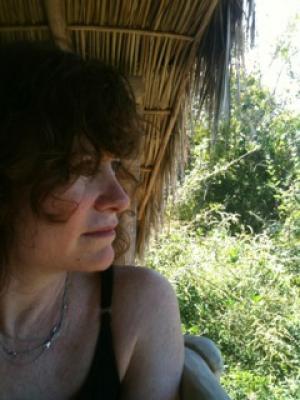 ABOUT CHRIS DESSER
Chris Desser is an artist, activist, attorney, On the Commons Fellow and curator of the Catalog of Extinct Experiences. She is co-author of Living With the Genie: Technology and the Quest For Human Master (Island Press, 2003) and co-founded Women’s Voice, Women Vote in 2003. Desser has served on the California Coastal Commission and the San Francisco Commission for the Environment as well as the boards of the Women Donors Network, The Rockwood Leadership Program, Patagonia, Mother Jones Magazine, and the Rainforest Action Network.