Featured Headlines
News by Subject
IEA acknowledges: Two-Thirds of Oil Must Stay in the Ground by 2050 to Avoid Climate Catastrophe
Republished from priceofoil.org
By Lorne Stockman
1 rating  

The International Energy Agency released its annual flagship publication yesterday, the World Energy Outlook. The IEA made an historic statement in the executive summary.

It said, “No more than one-third of proven reserves of fossil fuels can be consumed prior to 2050 if the world is to achieve the 2 °C goal”, the internationally recognized limit to average global warming in order to prevent catastrophic climate change.

Let me rephrase that.  Over two-thirds of today’s proven reserves of fossil fuels need to still be in the ground in 2050 in order to prevent catastrophic levels of climate change.

We congratulate the IEA for recognizing this crucial point and encourage the organization to prioritize this message in its presentations and public messaging. It is especially important given that the world’s fossil fuel industry is working overtime to increase its proven reserve base.

Let’s take the Canadian tar sands industry as an example. As the chart below shows,the tar sands industry has enough projects producing, under construction and approved to blow well past the climate limits prescribed by the IEA. Nevertheless even more projects are lined up for regulatory approval leading to a possible trebling of production capacity over and above the IEA limit.
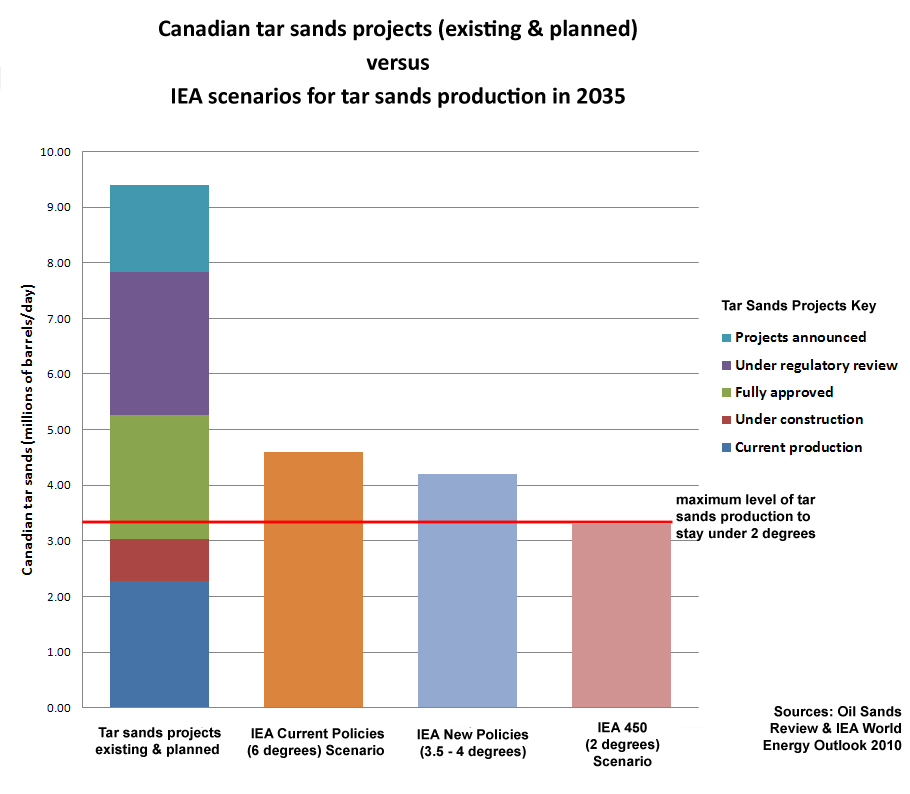
 

tar sands climate limits

(Click the graph for a larger view)

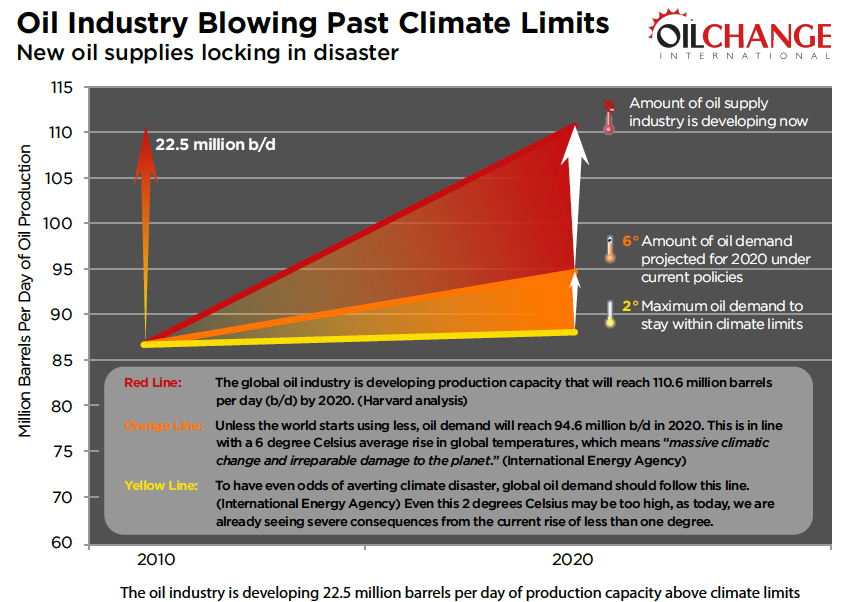
Globally, the oil industry as a whole is also lining up enough production capacity to cook the climate several times over.

According to one analysis, there could be as much as 110.6 million barrels of oil production capacity in 2020, while the IEA says that less than 90 million b/d is plenty, see the chart below.
 

That the IEA acknowledges the constraints on commercializing the world’s proven reserves is helpful, as the agency has a huge influence on global energy policy, particularly in the developed countries of the OECD, where the greatest per-capita consumption is concentrated.

But there is cause for even more caution over fossil fuel reserves than even this suggests.

The IEA’s calculations are based on having a 50% chance of constraining climate change to less than 2 degrees (C). Given that today the world’s climate is warmer by about 0.8 degrees (C) and we are already seeing some intense impacts, including record losses of Arctic sea ice, we may want to do more to ensure we stay below 2 degrees.

Last year, the London based Carbon Tracker Initiative calculated the proportion of proven fossil fuel reserves that could be consumed to have an 80% chance of hitting the 2 degree target. A target which I think many of us would be more comfortable with than one that basically gives us a 50/50 chance of failure. They found that proven reserves are five times over this limit. So some 80% of those reserves would need to stay in the ground.

This is a crucial conversation that needs to be had and we are glad the IEA is starting to engage in it. Especially as high energy prices are enabling new technologies to open up ever more reserves.

The IEA states in another section of the report that discusses the North American oil boom, a subject we will explore in a subsequent blog, that the fracking boom has enabled access to an additional 250 billion barrels of recoverable oil globally that was not in the IEA’s reserves figures in last year’s report.

It is clearly time for a coherent energy policy that keeps some fossil fuels in the ground.


Want to tell the President we can’t afford an All of the Above energy plan in light of this news? Sign our petition here.

Rate this story:
1 rating  
Added on November 13, 2012 by
Films For Action
2202 views
comments powered by Disqus
Recommended for You
Jerry Mander, author of "In the Absence of the Sacred" and "Four Arguments for the Elimination of Television", describes the drawbacks of television. An excerpt from the extended interviews of What A Way To Go: Life At The End Of Empire. A middle class white guy comes to grips with Peak Oil, Climate Change, Mass Extinction, Population Overshoot and the demise of the American Lifestyle. To...
Two thirds of all energy generated in the UK's nuclear, coal and gas fueled power stations is lost as waste heat - that's enough heat to meet the whole of the UK's heating and hot water needs. Made by BAFTA award-winning Memory Box Films and narrated by Clive Anderson, the film answers the crucial energy question facing the UK: how can we combat climate change and ensure energy security...
Santa Barbara is serious about lowering carbon emissions. Guided by a comprehensive greenhouse gas emissions study, they’re adding solar panels to city buildings, requiring lower energy usage for new buildings, switching to biodiesel and hybrid vehicles, and giving free bus passes to downtown workers. City councilmember Das Williams urges citizens to push officials to make substantive (i.e...
One response to the global crisis that is gaining enthusiastic momentum is the Transition Towns movement. Jennifer Gray, a pioneer in the Transition Initiative in the UK and cofounder of Transition US, describes it as “a community-led response to the twin crises of peak oil and climate change. It’s … positive, pro-active [and] engages the whole community in building resilience into their...
A middle class white guy comes to grips with Peak Oil, Climate Change, Mass Extinction, Population Overshoot and the demise of the American Lifestyle. Featuring interviews with Daniel Quinn, Derrick Jensen, Jerry Mander, Chellis Glendinning, Richard Heinberg, Thomas Berry, William Catton, Ran Prieur and Richard Manning. Produced by Sally Erickson. Written, Directed, and Edited by Tim Bennett...
Daniel Lerch, author of Post Carbon Cities: Planning for Energy and Climate Uncertainty, speaks to an audience in Hamilton, Ontario about some short and long term challenges that peak oil will cause for local governments. Global crises can have very local repercussions - but prompt planning can take the edge off of some of the negative effects. For more go to: www.postcarboncities.net.
"Plan B" provides a glimpse into a new and emerging economy based upon renewable resources as well as strategies to avoid the growing threat of climate change. As prices rise, oil insecurity deepens, and concerns about carbon emissions cast a shadow over the future of fossil fuels, wind, solar, and geothermal energy are replacing fossil fuels at a pace and on a scale previously...
Off-set your infidelity by paying someone else to be faithful. Just as good as carbon off-setting. http://visionon.tv http://climatecamp.org.uk Editor's note: While climate change is indisputably real, two of the most prominent solutions promoted by big business are, as you'd expect, short-sighted half-measures invented to profit off of climate change without addressing the root problem...
Former energy analyst Jan Lundberg opens by singing "Have A Global Warming Day" and closes with "The Depaver's Song." In between is an unabashed look at climate distortion, peak oil, and declining ecosystems, all bringing a necessary collapse of our "pigging out" economy. He envisions a future with radically curtailed energy use, and people coming together to find local solutions.
Peak Moment 26: Author Guy Dauncey's lively, optimistic solutions for Peak Oil and climate crisis are do-able here and now. Conservation, efficiency, proven technologies, and emerging innovations will take us through this critical planetary energy transition.
Actions
Bill McKibben and the folks at 350.org have decided to target the pernicious financial influence of the fossil fuel industry and its front groups. On the day following the...
Activity
Thorium is readily available & can be turned into energy without generating transuranic wastes. Thorium's capacity as nuclear fuel was discovered during WW II, but...
Petition
One of the main causes of deforestation in Indonesia, and the greatest threat to orangutans in the wild, is the conversion of forests to oil palm plantations. As more and more...
Campaign
Climate change is accelerating, but there’s a massive ray of hope: clean energy is booming, producing nearly 20% of the world's electricity! Incredibly, the US and EU...
Petition
THREE great (FREE) films at the Brecht Forum - Sunday April 21 at 4:00 PM Meetup.com and the Brecht Forum are being kind enough to allow us to screen three fantastic...
Activity
Don't Miss Our Best Content!
Like Us On Facebook
Get Our Weekly Newsletter